Fisetin
Fisetin is a naturally occurring flavonoid found in strawberries, apples, and other fruits that has emerged as one of the most promising senolytic compounds, capable of selectively clearing senescent cells to slow biological aging. It also possesses potent antioxidant, anti-inflammatory, and neuroprotective properties.
Evidence-led profile
Research snapshot
- Evidence stage
- Emerging research
- References
- 8 linked sources
- Research coverage
- 1 area
- Editorial review
- Mar 8, 2026
Published by the PepGuide Editorial Team using our research methodology.
Overview
Fisetin (3,3',4',7-tetrahydroxyflavone) is a bioactive flavonol belonging to the polyphenol class of compounds, found naturally in various fruits and vegetables with the highest concentrations in strawberries, apples, persimmons, onions, and cucumbers. While it shares structural similarities with quercetin, fisetin has distinct pharmacological properties and has attracted intense scientific interest due to landmark research at the Mayo Clinic identifying it as the most potent natural senolytic agent tested.
The senolytic properties of fisetin represent its most exciting therapeutic potential. Senescent cells — aged, dysfunctional cells that resist apoptosis and secrete inflammatory factors (the senescence-associated secretory phenotype, or SASP) — accumulate with age and contribute to chronic disease and tissue deterioration. Studies in aged mice demonstrated that intermittent fisetin treatment reduced senescent cell burden, decreased age-related inflammation, improved tissue function, and extended median lifespan by approximately 10%. Clinical trials including the AFFIRM-LITE study are currently evaluating fisetin's senolytic effects in humans, particularly in older adults and individuals with age-related conditions.
Beyond senolytics, fisetin demonstrates robust neuroprotective activity, maintaining glutathione levels in neurons, inhibiting oxidative stress-induced cell death, and reducing neuroinflammation through modulation of NF-kB and MAPK pathways. Preclinical studies have shown benefits in models of Alzheimer's disease, stroke, and traumatic brain injury. Fisetin also supports metabolic health, inhibits cancer cell proliferation through multiple mechanisms, and has shown cardioprotective effects. Its relatively low bioavailability has led to development of enhanced formulations, and typical senolytic dosing protocols use intermittent high-dose regimens rather than continuous low-dose supplementation.
Research
Reported Effects
Senolytic Protocol Success:: Mayo Clinic protocol (20mg/kg for 2 days) appears well-tolerated and effective for many users targeting cellular senescence. Bioavailability Challenges:: Research confirms poor water solubility and absorption issues, though users report benefits even with standard supplements when dosed appropriately. Synergistic Effects:: Users commonly stack fisetin with quercetin for enhanced senolytic effects, and with other longevity compounds like resveratrol, NMN, and metformin. Timeline for Results:: Physical benefits like joint pain reduction reported within weeks to months; cognitive effects may be noticed sooner
Safety and Limitations
Common Side Effects
- Generally well-tolerated at standard supplemental doses (100–500 mg/day)
- Mild gastrointestinal symptoms including nausea, bloating, and diarrhea reported infrequently
- Headache and mild dizziness occur occasionally
- Fisetin is a potent senolytic at high doses, and some users report transient fatigue or malaise during the initial days of intermittent high-dose protocols, sometimes described as a "senolytic flu"
Serious Adverse Effects
- Long-term human safety data is limited; most safety information derives from preclinical studies and short-term human trials
- At very high doses used in senolytic protocols (up to 20 mg/kg for multiple consecutive days), the safety profile is not fully characterized
- Theoretical concern for excessive clearance of senescent cells leading to impaired wound healing or tissue repair, though this has not been confirmed in humans
- Mild anticoagulant properties at high doses may increase bleeding risk in susceptible individuals
- Potential for kidney stress at extreme doses due to poor aqueous solubility and renal excretion of metabolites
Contraindications
- Individuals with bleeding disorders or on anticoagulant therapy should exercise caution due to mild blood-thinning properties
- Pregnant and breastfeeding women should avoid supplementation entirely due to lack of reproductive safety data and potential senolytic effects on developing tissues
- Patients with impaired kidney function should consult a physician, particularly before high-dose senolytic protocols
- Individuals scheduled for surgery should discontinue use at least one to two weeks prior
Drug Interactions
- Inhibits several cytochrome P450 enzymes (CYP1A2, CYP2C9, CYP3A4), potentially increasing serum concentrations of drugs metabolized through these pathways
- May potentiate the effects of anticoagulant and antiplatelet medications (warfarin, aspirin, clopidogrel)
- Potential interaction with chemotherapy agents; while some preclinical data suggests synergy, fisetin may also interfere with certain cytotoxic mechanisms
- May interact with immunosuppressants given its effects on inflammatory signaling pathways (NF-kB, PI3K/Akt)
- Possible additive effects with other senolytic compounds (dasatinib, quercetin) requiring careful dose management
Population-Specific Considerations
- Older adults are the primary population using fisetin for senolytic purposes; gradual dose escalation is advised
- Individuals with cancer should not self-administer fisetin without oncologist guidance due to complex interactions with tumor biology
- The Mayo Clinic AFFIRM trial and similar ongoing studies will provide more definitive safety data for high-dose intermittent use
Common Side Effects
- Mild Fatigue:: Most common side effect is temporary tiredness or lethargy after first day of high-dose protocol, typically resolving by second day
- Generally Well-Tolerated:: Majority of users report no adverse effects even at very high senolytic doses (2+ grams daily)
- Minimal Gastrointestinal Issues:: Unlike many supplements, fisetin appears to cause few digestive complaints even at high doses
- Unknown Long-term Effects:: As a relatively new biohacking intervention, long-term safety data from human use remains limited
Mechanism of Action
Senolytic Activity
Fisetin (3,3',4',7-tetrahydroxyflavone) is a naturally occurring flavonoid found in strawberries, apples, and persimmons that has emerged as one of the most potent naturally-derived senolytic agents — compounds that selectively eliminate senescent cells. Fisetin inhibits the PI3K/Akt/mTOR and p53/p21/serpine anti-apoptotic pathways that senescent cells depend on for survival (the senescent cell anti-apoptotic pathways, or SCAPs). By suppressing Bcl-2, Bcl-xL, and other pro-survival proteins upregulated in senescent cells, fisetin reactivates apoptotic signaling, selectively clearing senescent cells while sparing proliferating cells (PMID: 30279143).
Kinase Inhibition & Anti-Inflammatory Pathways
Fisetin directly inhibits multiple kinases including CDK2/CDK4 (cyclin-dependent kinases), PI3K, Akt, and mTOR, disrupting pro-survival and pro-proliferative signaling in cancer and senescent cells. It potently suppresses NF-kB signaling by inhibiting IKK-beta and p65 nuclear translocation, reducing expression of TNF-alpha, IL-1beta, IL-6, COX-2, and iNOS. Fisetin also inhibits MAPK/ERK and JAK/STAT3 pathways, which drive inflammation and cell survival (PMID: 22178179).
Neuroprotective Mechanisms
Fisetin activates the Ras-ERK-CREB pathway in neurons, promoting neurotrophic factor expression (BDNF) and long-term potentiation. It maintains intracellular glutathione levels by upregulating the Nrf2/ARE pathway, protecting neurons against oxidative and excitotoxic damage. Fisetin also inhibits 5-lipoxygenase, reducing neuroinflammatory leukotriene production, and suppresses microglial activation (PMID: 24389933).
Epigenetic Modulation
Fisetin inhibits the activity of DNA methyltransferases (DNMTs) and histone deacetylases (HDACs), promoting re-expression of tumor suppressor genes silenced by epigenetic modification. It also modulates SIRT1 activity, enhancing deacetylation of p53 and NF-kB, contributing to both anti-cancer and anti-inflammatory effects (PMID: 24489112).
Molecular Structure
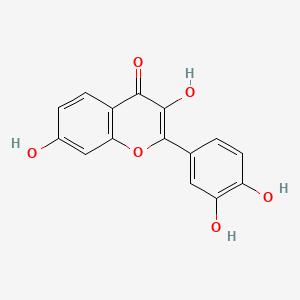
- Formula
- C15H10O6
- Weight
- 286.24 Da
- PubChem CID
- 5281614
- Exact Mass
- 286.0477 Da
- LogP
- 2
- TPSA
- 107 Ų
- H-Bond Donors
- 4
- H-Bond Acceptors
- 6
- Rotatable Bonds
- 1
- Complexity
- 459
Identifiers (SMILES, InChI)
InChI=1S/C15H10O6/c16-8-2-3-9-12(6-8)21-15(14(20)13(9)19)7-1-4-10(17)11(18)5-7/h1-6,16-18,20H
XHEFDIBZLJXQHF-UHFFFAOYSA-NReferences (8)
- [1]Intermittent Supplementation With Fisetin Improves Physical Function and Decreases Cellular Senescence in Skeletal Muscle With Aging: A Comparison to Genetic Clearance of Senescent Cells and Synthetic Senolytic Approaches
→ Oral intermittent fisetin treatment (1 week on-2 weeks off-1 week on) improved frailty and grip strength in old mice by reducing cellular senescence and SASP-related inflammation in skeletal muscle.
- [2]Intermittent supplementation with fisetin improves arterial function in old mice by decreasing cellular senescence
→ Intermittent fisetin supplementation improved endothelial function and reduced vascular cell senescence and inflammation markers in aged mice, demonstrating benefits for cardiovascular health.
- [3]Fisetin from Dietary Supplement to a Drug Candidate: An Assessment of Potential
→ Comprehensive review identifying fisetin's neurotrophic, anti-inflammatory, anti-carcinogenic, and anti-diabetic properties, while noting challenges with water solubility and oral bioavailability requiring novel delivery systems.
- [4]Fisetin-In Search of Better Bioavailability-From Macro to Nano Modifications: A Review
→ Review demonstrating that nanotechnology-based delivery methods can significantly improve fisetin's limited water solubility, poor absorption, and low bioavailability to enhance therapeutic efficacy.
- [5]Fisetin, a potential caloric restriction mimetic, attenuates senescence biomarkers in rat erythrocytes
→ Fisetin supplementation (15 mg/kg) for 6 weeks in aged rats suppressed aging-induced increases in reactive oxygen species, cell death, and oxidative damage markers, functioning as a caloric restriction mimetic.
- [6]Fisetin regulates obesity by targeting mTORC1 signaling
→ Fisetin prevented diet-induced obesity by inhibiting mTORC1 signaling in an Akt-dependent manner, reducing adipocyte differentiation and lipid accumulation in cell culture and animal models.
- [7]Inhibition mechanism of fisetin on acetylcholinesterase and its synergistic effect with galantamine
→ Fisetin demonstrated mixed-mode inhibition of acetylcholinesterase (IC50 = 8.88 μM) with potential synergistic effects when combined with galantamine, suggesting benefits for Alzheimer's disease treatment.
- [8]Regulatory effects of fisetin on microglial activation
→ Fisetin reduced neuroinflammation by modulating microglial activation and inflammatory mediator production, demonstrating neuroprotective potential through anti-inflammatory mechanisms.
Continue researching Fisetin
Keep scientific evidence separate from commercial availability. Review how claims are evaluated, explore question-led research paths, or inspect disclosed source records without changing the editorial conclusions on this page.