Ginsenosides
Ginsenosides are a diverse class of steroidal saponins found exclusively in the Panax genus that serve as the primary bioactive compounds responsible for ginseng's adaptogenic, neuroprotective, and immunomodulatory effects.
Evidence-led profile
Research snapshot
- Evidence stage
- Emerging research
- References
- 5 linked sources
- Research coverage
- 1 area
- Editorial review
- Mar 8, 2026
Published by the PepGuide Editorial Team using our research methodology.
Overview
Ginsenosides are a family of triterpene saponins found almost exclusively in plants of the genus Panax, including Panax ginseng (Asian ginseng), Panax quinquefolius (American ginseng), and Panax notoginseng (Sanqi). Over 150 individual ginsenosides have been identified, classified primarily into two structural groups based on their aglycone backbone: protopanaxadiol (PPD) types (including Rb1, Rb2, Rc, Rd, Rg3, and Rh2) and protopanaxatriol (PPT) types (including Re, Rf, Rg1, Rg2, and Rh1). A third minor group, the oleanane-type (Ro), also exists.
The pharmacological diversity of ginsenosides is remarkable, with different compounds often exerting opposing or complementary effects. For example, Rg1 is generally stimulatory and promotes neurogenesis, while Rb1 tends to be sedative and neuroprotective through different mechanisms. This biphasic activity underlies ginseng's classification as an adaptogen—a substance that normalizes physiological function regardless of the direction of imbalance. Ginsenosides interact with a wide array of molecular targets including steroid hormone receptors, ion channels, GABA receptors, and various intracellular signaling cascades.
Research has established ginsenosides' roles in neuroprotection, cardiovascular health, immune modulation, anti-cancer activity, and metabolic regulation. Gut microbiota play a crucial role in ginsenoside metabolism, converting parent compounds into more bioactive metabolites such as compound K and protopanaxatriol, which may account for individual variability in ginseng response. Standardized extracts are typically quantified by total ginsenoside content, with therapeutic doses generally providing 20-60 mg of combined ginsenosides daily. Processing methods significantly affect ginsenoside profiles—red ginseng (steamed) contains unique degradation products like Rg3 and Rh2 that are absent in white (dried) ginseng.
Research
Reported Effects
Species Variance:: Asian ginseng (Panax ginseng) is generally regarded as more stimulating, while American ginseng (Panax quinquefolius) is often seen as more calming.. Long-term Benefits:: While some energy effects are immediate, the adaptogenic benefits for stress and homeostasis typically accumulate over weeks of consistent use.. Rare Ginsenosides:: Rare variants like Rg3 and Rh2 are noted for higher bioactivity but are harder to find in standard whole-root supplements.. Bioavailability:: The effectiveness can be limited by low natural absorption rates, leading to a need for high-quality extracts or biotechnologically enhanced versions.
Safety and Limitations
Safety Profile: Ginsenosides
Common Side Effects
- Insomnia and restlessness (most frequently reported, ~10–15% of users): due to CNS stimulatory activity, particularly with Rg1-predominant preparations
- Gastrointestinal symptoms: nausea, diarrhea, abdominal pain, and bloating
- Headache, especially during the first 1–2 weeks of supplementation
- Elevated blood pressure (typically mild; dose-dependent)
- Breast tenderness and menstrual changes in women (estrogenic effects of Rg1 and other ginsenosides)
- Skin rash, pruritus, and morning diarrhea (part of the classically described "ginseng abuse syndrome" with chronic high-dose use)
Serious Adverse Effects
- Ginseng abuse syndrome: chronic high-dose use (>15 g/day of root equivalent) may cause hypertension, nervousness, insomnia, skin eruptions, and morning diarrhea
- Hypertension and tachycardia: sympathomimetic effects may precipitate hypertensive urgency, particularly in predisposed individuals
- Bleeding events: ginsenosides (particularly Rg1 and Rg3) inhibit platelet aggregation; subdural hematoma, vaginal bleeding, and epistaxis reported with ginseng products
- Estrogenic stimulation: may promote growth of hormone-sensitive cancers (breast, endometrial); Rg1 activates ER-alpha
- Hypoglycemia: ginsenosides Rb1 and Rg1 enhance insulin sensitivity and glucose uptake; dangerous in combination with diabetes medications
- Manic episodes: documented in patients with bipolar disorder; also reported in previously undiagnosed individuals
- Stevens-Johnson syndrome: rare but documented with ginseng products
- Hepatotoxicity: rare cases of drug-induced liver injury
- Neonatal androgenization: case report of androgenization in a neonate whose mother consumed ginseng during pregnancy
Contraindications
- Known allergy to Panax ginseng, Panax quinquefolius (American ginseng), or Araliaceae family
- Uncontrolled hypertension
- Estrogen-receptor-positive breast cancer or other hormone-sensitive malignancies
- Bipolar disorder or schizophrenia (risk of mania or psychosis)
- Active bleeding or scheduled surgery (discontinue at least 7 days prior)
- Pregnancy (estrogenic effects, potential neonatal androgenization)
- Children under 12 years (insufficient safety data)
Drug Interactions
- Warfarin: complex interaction; some ginsenosides decrease INR while others increase bleeding risk; mandatory INR monitoring
- Antidiabetic medications: additive hypoglycemia risk; blood glucose monitoring required
- MAO inhibitors (phenelzine, tranylcypromine): risk of headache, tremor, mania; avoid combination
- Stimulants and caffeine: additive CNS stimulation; insomnia, anxiety, and tachycardia
- Antihypertensives: unpredictable interaction; may counteract or potentiate blood pressure effects depending on ginsenoside profile
- Immunosuppressants (cyclosporine, tacrolimus): ginsenosides have immunostimulatory activity that may oppose immunosuppression
- Estrogen-containing medications: additive estrogenic effects
- CYP3A4 and CYP2D6 substrates: ginsenosides may inhibit these enzymes, potentially increasing levels of numerous medications
- Imatinib and other kinase inhibitors: potential pharmacokinetic interaction via CYP3A4 inhibition
- Loop diuretics (furosemide): ginseng may oppose diuretic effects
Population-Specific Considerations
- Pregnant women: contraindicated; estrogenic activity and case reports of neonatal androgenization
- Breastfeeding: insufficient safety data; avoid concentrated extracts
- Children: not recommended under 12 years; no established pediatric dosing
- Elderly: most commonly studied population; start with low doses, monitor blood pressure, blood glucose, and bleeding parameters; review all concurrent medications
- Diabetic patients: potentially beneficial for glucose control but requires close monitoring; adjust medication doses as needed
- Hypertensive patients: monitor blood pressure closely; avoid Rg1-predominant preparations
- Pre-surgical patients: discontinue all ginseng products at least 7 days before surgery
Common Side Effects
- Insomnia:: Taken too late in the day, ginseng can cause sleeplessness or poor sleep quality due to its stimulating nature.
- Hypertension:: Some users and research papers note potential increases in blood pressure, necessitating caution for those with cardiovascular issues.
- Estrogen-like Effects:: May cause breast pain or vaginal bleeding in some women due to potential phytoestrogenic activity.
- Drug Interactions:: Known to decrease the effectiveness of blood thinners like warfarin and may enhance the effects of sedative medications.
Mechanism of Action
Ginsenosides are a class of over 100 triterpenoid saponins found in Panax ginseng, classified into protopanaxadiol (PPD: Rb1, Rb2, Rc, Rd, Rg3, Rh2) and protopanaxatriol (PPT: Re, Rf, Rg1, Rh1) groups based on their aglycone structure. Their structural similarity to steroid hormones allows them to interact with glucocorticoid and androgen receptors as partial agonists, while they also modulate ionotropic neurotransmitter receptors including GABAa (potentiation), NMDA (modulation), nicotinic acetylcholine, and 5-HT3 (inhibition).
At the intracellular signaling level, ginsenosides activate the PI3K/Akt pathway to promote cell survival, neurogenesis, and VEGF-mediated angiogenesis, with ginsenoside Rd being particularly active in this regard. AMPK activation by ginsenosides regulates energy homeostasis, improving glucose uptake and fatty acid oxidation. The anti-inflammatory effects are primarily mediated through NF-κB pathway inhibition, reducing production of TNF-α, IL-1β, IL-6, COX-2, and iNOS.
The MAPK signaling response to ginsenosides is tissue-dependent: in neurons, Rg1 blocks JNK phosphorylation to prevent stress-induced apoptosis, while in cancer cells, Rg3 and Rh2 activate JNK/p38 and caspase-3/caspase-9 cascades to induce apoptosis. Ginsenosides also stimulate endothelial nitric oxide synthase (eNOS) in vascular endothelial cells to produce nitric oxide, promoting vasodilation and cardiovascular protection. This multi-target mechanism underlies the adaptogenic properties attributed to ginseng preparations.
Research protocol summary
- Typical Dose
- Common doses range from 200mg to 400mg per day of an extract standardized to at least 4-7% ginsenosides.
These values summarize cataloged research protocols. They are not personal dosing instructions or medical guidance.
Molecular Structure
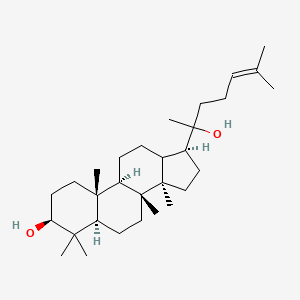
- Formula
- C30H52O2
- Weight
- 444.7 Da
- PubChem CID
- 3086007
- Exact Mass
- 444.3967 Da
- LogP
- 8.5
- TPSA
- 40.5 Ų
- H-Bond Donors
- 2
- H-Bond Acceptors
- 2
- Rotatable Bonds
- 4
- Complexity
- 750
Identifiers (SMILES, InChI)
InChI=1S/C30H52O2/c1-20(2)10-9-16-30(8,32)22-13-18-28(6)21(22)11-12-24-27(5)17-15-25(31)26(3,4)23(27)14-19-29(24,28)7/h10,21-25,31-32H,9,11-19H2,1-8H3/t21?,22-,23-,24+,25-,27-,28+,29+,30?/m0/s1
NLHQJXWYMZLQJY-SWIZOJJJSA-NReferences (5)
- [3]Anti-ageing active ingredients from herbs and nutraceuticals used in traditional Chinese medicine: pharmacological mechanisms and implications for drug discovery
→ Highlights ginsenoside Rg1 as a key anti-aging ingredient that may slow the rate of functional decline in cells and tissues.
- [1]Pharmacological Effects of Ginseng: Multiple Constituents and Multiple Actions on Humans
→ Reviews how ginseng acts as an adaptogen that protects the body against stress, stabilizes physiological processes, and restores homeostasis across various body systems.
- [2]Molecular-Signaling Pathways of Ginsenosides Rb in Myocardial Ischemia-Reperfusion Injury: A Mini Review
→ Identifies specific ginsenosides (Rb1, Rb2, Rb3) that exert cardioprotective effects by modulating oxidative stress, inflammation, and apoptotic pathways.
- [4]Hormesis and embryonic stem cells
→ Demonstrates that ginsenosides induce hormetic dose responses that stimulate stem cell renewal and differentiation, suggesting therapeutic potential for tissue repair.
- [5]Traditional and Current Use of Ginseng
→ Discusses the use of Asian and American ginseng as a 'panacea' for wellness and wellness enhancement while noting the importance of reputable sourcing due to lack of standardization.
Continue researching Ginsenosides
Keep scientific evidence separate from commercial availability. Review how claims are evaluated, explore question-led research paths, or inspect disclosed source records without changing the editorial conclusions on this page.