Choline Bitartrate
Choline bitartrate is a salt form of choline, an essential nutrient involved in neurotransmitter synthesis, cell membrane structure, and methyl group metabolism. It is one of the most affordable and widely available choline supplements.
Evidence-led profile
Research snapshot
- Evidence stage
- Emerging research
- References
- 8 linked sources
- Research coverage
- 1 area
- Editorial review
- Mar 8, 2026
Published by the PepGuide Editorial Team using our research methodology.
Overview
Choline bitartrate is a dietary supplement combining choline with tartaric acid to form a stable, water-soluble salt. Choline was officially recognized as an essential nutrient by the Institute of Medicine in 1998, as the human body cannot synthesize sufficient quantities to meet metabolic demands. It serves as a precursor to acetylcholine, the neurotransmitter critical for memory, muscle control, and autonomic nervous system function, as well as phosphatidylcholine, a major component of cell membranes.
Beyond neurotransmission and structural roles, choline is essential for lipid transport from the liver via very-low-density lipoproteins (VLDL), and inadequate choline intake is associated with fatty liver disease. Choline also participates in one-carbon metabolism as a methyl group donor through its oxidized form, betaine, influencing homocysteine metabolism and epigenetic regulation through DNA methylation. Dietary sources include eggs, liver, and soybeans, though many individuals do not meet the adequate intake levels through diet alone.
Choline bitartrate is among the least expensive choline supplements available, though it contains a lower percentage of elemental choline by weight (approximately 41%) compared to other forms. Notably, it has relatively limited ability to cross the blood-brain barrier compared to forms such as alpha-GPC or CDP-choline, which may limit its efficacy for cognitive enhancement specifically. It remains useful for addressing general choline insufficiency and supporting liver function. Side effects at high doses may include fishy body odor, gastrointestinal distress, and excessive sweating.
Research
Reported Effects
Individual Variability:: Effectiveness is highly dependent on baseline choline levels and individual deficiency status, with those deficient experiencing dramatic benefits while others may see minimal effects. Dosage-Dependent Response:: Benefits typically observed at moderate doses (400-1600 mg), but excessive intake leads to diminishing returns and increased side effects including brain fog and fatigue. Form Matters:: Users note that choline bitartrate is less potent than other forms like Alpha-GPC or CDP-choline, requiring higher doses to achieve similar cognitive effects. Genetic Factors:: Individuals with PEMT or MTHFR mutations may have greater choline needs and respond more dramatically to supplementation
Safety and Limitations
Safety Profile: Choline Bitartrate
Common Side Effects
- Fishy body odor (trimethylaminuria-like): the most characteristic side effect, caused by gut bacterial conversion of choline to trimethylamine (TMA); dose-dependent and affects ~10–15% of users
- Gastrointestinal disturbances: nausea, diarrhea, abdominal cramping, and bloating
- Excessive salivation and sweating at higher doses
- Mild headache or dizziness, particularly during dose titration
Serious Adverse Effects
- Trimethylamine N-oxide (TMAO) elevation: chronic high-dose choline intake increases circulating TMAO, which has been associated with increased cardiovascular disease risk in observational studies (though causality remains debated)
- Hypotension: cholinergic effects can cause a drop in blood pressure at very high doses (>3.5 g/day)
- Hepatotoxicity: paradoxically, while choline prevents fatty liver, extremely high doses may cause liver enzyme elevation
- Rare cholinergic crisis symptoms at toxic doses: excessive sweating, bradycardia, hypersalivation
Contraindications
- Known trimethylaminuria (TMAU / "fish odor syndrome")—exacerbates symptoms
- Active Parkinson's disease treated with anticholinergics (may counteract therapeutic intent)
- Severe hypotension or bradycardia
- Renal failure (impaired TMA/TMAO clearance)
Drug Interactions
- Anticholinergic medications (benztropine, trihexyphenidyl, atropine): choline may reduce effectiveness of these drugs
- Cholinesterase inhibitors (donepezil, rivastigmine, galantamine): additive cholinergic effects; risk of cholinergic toxicity
- Methotrexate: both affect folate/methyl metabolism; choline may alter methotrexate efficacy
- Betaine / methyl donors: stacking with TMG or SAMe increases total methyl donor load and TMAO production
Population-Specific Considerations
- Pregnancy: choline is essential (AI = 450 mg/day during pregnancy); adequate intake supports fetal brain development; supplementation is generally safe at recommended doses
- Lactation: AI increases to 550 mg/day; supplementation generally well-tolerated
- Cardiovascular disease: discuss TMAO concerns with a cardiologist before chronic high-dose supplementation
- Kidney disease: impaired TMAO clearance may amplify cardiovascular risk; dose adjust or avoid
- Genetic FMO3 variants: individuals with reduced flavin-containing monooxygenase 3 activity are more prone to fishy odor; consider lower doses or alternative choline forms (e.g., alpha-GPC, CDP-choline)
Common Side Effects
- Headaches and Tension:: Commonly reported side effect, particularly in those not deficient or taking excessive amounts; can indicate choline excess
- Mood Disturbances:: Some users experience depression, emotional blunting, anhedonia, or increased anxiety, particularly when combined with other mood-affecting supplements
- Brain Fog and Fatigue:: Paradoxically, too much choline causes severe brain fog, mental fatigue, and poor mood; more is not better
- Digestive Issues:: Some users report nausea, gas, or gastrointestinal discomfort, particularly when taken on an empty stomach or at high doses
Mechanism of Action
Quaternary Ammonium Nutrient — Acetylcholine Precursor
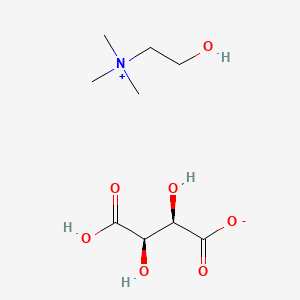
Choline bitartrate provides choline (2-hydroxy-N,N,N-trimethylethanaminium) complexed with tartaric acid for improved stability and hygroscopicity. Choline is an essential nutrient classified by the IOM as required for three critical metabolic pathways. As the direct precursor to acetylcholine (ACh), choline is taken up by cholinergic nerve terminals via the high-affinity choline transporter (CHT1/SLC5A7) and acetylated by choline acetyltransferase (ChAT) to produce ACh — the primary neurotransmitter mediating neuromuscular junction transmission, parasympathetic autonomic function, and hippocampal/cortical cognitive circuits (PMID: 19906421).
Phosphatidylcholine Synthesis — Kennedy Pathway
Choline enters the CDP-choline (Kennedy) pathway through sequential phosphorylation by choline kinase to phosphocholine, conversion to CDP-choline by CTP:phosphocholine cytidylyltransferase (CCT, the rate-limiting step), and transfer of the phosphocholine moiety to diacylglycerol (DAG) by cholinephosphotransferase to yield phosphatidylcholine (PC). PC comprises approximately 50% of mammalian membrane phospholipids and is the primary phospholipid in VLDL particles required for hepatic triglyceride export. Choline deficiency causes hepatic steatosis due to impaired VLDL assembly and secretion (PMID: 17568692).
Methyl Donor — One-Carbon Metabolism
Choline is irreversibly oxidized in hepatic mitochondria by choline dehydrogenase to betaine aldehyde, then to betaine (trimethylglycine) by betaine aldehyde dehydrogenase. Betaine serves as a methyl donor for betaine-homocysteine S-methyltransferase (BHMT), converting homocysteine to methionine — an alternative remethylation pathway to the folate/B12-dependent methionine synthase reaction. This links choline metabolism to the methionine-SAM cycle, epigenetic DNA and histone methylation, and homocysteine clearance (PMID: 18469271).
Limitations of Bitartrate Form
Choline bitartrate provides approximately 41% choline by weight and relies on passive diffusion for blood-brain barrier crossing, resulting in modest central cholinergic effects compared to CDP-choline or alpha-GPC. Its primary utility is in preventing choline deficiency, supporting hepatic function, and maintaining peripheral cholinergic tone (PMID: 21387326).
Research protocol summary
- Typical Dose
- Most users report taking 400-1600 mg of choline bitartrate daily, with 400-500 mg being common in research studies
These values summarize cataloged research protocols. They are not personal dosing instructions or medical guidance.
Molecular Structure
- Formula
- C9H19NO7
- Weight
- 253.25 Da
- PubChem CID
- 6900
- Exact Mass
- 253.1162 Da
- TPSA
- 138 Ų
- H-Bond Donors
- 4
- H-Bond Acceptors
- 7
- Rotatable Bonds
- 4
- Complexity
- 193
Identifiers (SMILES, InChI)
InChI=1S/C5H14NO.C4H6O6/c1-6(2,3)4-5-7;5-1(3(7)8)2(6)4(9)10/h7H,4-5H2,1-3H3;1-2,5-6H,(H,7,8)(H,9,10)/q+1;/p-1/t;1-,2-/m.1/s1
QWJSAWXRUVVRLH-LREBCSMRSA-MReferences (8)
- [1]Choline supplements: An update
→ Comprehensive review examining different forms of choline supplementation including choline bitartrate, showing they are effective precursors of acetylcholine and represent an effective strategy for boosting memory and enhancing cognitive function.
- [3]Maternal choline supplementation during the third trimester of pregnancy improves infant information processing speed
→ Randomized controlled trial showing that maternal choline supplementation (930 mg/day) during the third trimester significantly improved infant information processing speed compared to 480 mg/day.
- [4]Choline Intake as Supplement or as a Component of Eggs Increases Plasma Choline and Reduces Interleukin-6 without Modifying Plasma Cholesterol in Participants with Metabolic Syndrome
→ Study in metabolic syndrome patients found that both choline bitartrate supplementation (~400 mg/day) and whole eggs increased plasma choline and reduced inflammatory marker IL-6 without negatively affecting cholesterol levels.
- [5]Intake of 3 Eggs per Day When Compared to a Choline Bitartrate Supplement, Downregulates Cholesterol Synthesis without Changing the LDL/HDL Ratio
→ Crossover study comparing 3 eggs/day to choline bitartrate supplement (~400 mg choline) found that eggs downregulated cholesterol synthesis without adversely affecting LDL/HDL ratios in healthy young adults.
- [6]Oral supplementation of choline attenuates the development of alcohol-related liver disease (ALD)
→ Mouse study demonstrating that oral choline supplementation (2.7 g/kg diet) attenuated the development of alcohol-related liver damage, markers of intestinal permeability, and microbiota alterations.
- [7]Choline-related-inherited metabolic diseases-A mini review
→ Review discussing choline's involvement in cell membrane integrity, cholinergic neurotransmission, and methylation, noting that low choline levels relate to organ dysfunction, while adequate intake shows positive effects on memory and cardiovascular health.
- [8]Transposable elements: targets for early nutritional effects on epigenetic gene regulation
→ Landmark study showing that dietary methyl supplementation including choline in pregnant mice altered offspring phenotype via increased DNA methylation, demonstrating choline's role in epigenetic gene regulation.
- [2]Choline, Neurological Development and Brain Function: A Systematic Review Focusing on the First 1000 Days
→ Systematic review finding that choline supplementation during the first 1000 days of life supports normal brain development and protects against neural and metabolic insults, particularly when the fetus is exposed to alcohol.
Continue researching Choline Bitartrate
Keep scientific evidence separate from commercial availability. Review how claims are evaluated, explore question-led research paths, or inspect disclosed source records without changing the editorial conclusions on this page.