SAMe
S-adenosylmethionine, the body's principal methyl donor involved in over 100 methylation reactions, clinically demonstrated to support mood, joint health, and liver function through its roles in neurotransmitter synthesis, cartilage maintenance, and hepatic detoxification.
Evidence-led profile
Research snapshot
- Evidence stage
- Emerging research
- References
- 7 linked sources
- Research coverage
- 1 area
- Editorial review
- Jul 7, 2026
Published by the PepGuide Editorial Team using our research methodology.
Overview
S-Adenosylmethionine (SAMe, also written SAM-e or AdoMet) is a naturally occurring molecule synthesized from methionine and ATP by the enzyme methionine adenosyltransferase (MAT). It is the most prolific methyl donor in human biochemistry, participating in over 100 distinct methylation reactions catalyzed by methyltransferases throughout the body. These reactions are essential for neurotransmitter synthesis and degradation (methylation of norepinephrine to epinephrine, serotonin to melatonin, and catechol-O-methyltransferase activity), DNA and histone methylation (epigenetic regulation), phospholipid methylation (cell membrane fluidity and signaling), and polyamine synthesis (cell growth and differentiation). After donating its methyl group, SAMe is converted to S-adenosylhomocysteine (SAH) and subsequently to homocysteine, which can be remethylated back to methionine by folate- and vitamin B12-dependent pathways, completing the methionine cycle.
SAMe's three most evidence-based therapeutic applications are depression, osteoarthritis, and liver disease. For depression, SAMe has been evaluated in over 40 clinical trials, with meta-analyses demonstrating efficacy superior to placebo and comparable to tricyclic antidepressants, with faster onset of action and fewer side effects. Its antidepressant mechanism involves enhancement of monoamine neurotransmitter synthesis (serotonin, dopamine, norepinephrine) through methylation-dependent pathways and improvement of neuronal membrane fluidity through phospholipid methylation. For osteoarthritis, SAMe has shown efficacy comparable to NSAIDs (including celecoxib and naproxen) in multiple head-to-head trials, with a slower onset (2-4 weeks) but equivalent pain relief and functional improvement at 8-12 weeks, attributed to its role in proteoglycan and collagen synthesis within articular cartilage and its anti-inflammatory effects.
For liver disease, SAMe plays a critical role in hepatic glutathione synthesis — it is the precursor to cysteine (via the transsulfuration pathway), making it essential for maintaining glutathione levels in the liver. Clinical trials have demonstrated benefit in alcoholic liver disease, cholestasis of pregnancy, and drug-induced liver injury, with improvements in liver enzymes, bilirubin levels, and symptoms. SAMe is depleted in liver disease due to impaired MAT activity, creating a vicious cycle that supplementation can interrupt. Typical dosing ranges from 400-1,600 mg/day (divided doses, taken on an empty stomach), with enteric-coated tablets preferred for stability. SAMe requires adequate B12, folate, and B6 for proper methionine cycle function. It should be used with caution in bipolar disorder (may trigger mania) and avoided with serotonergic medications due to serotonin syndrome risk.
Research
Reported Effects
Individual Variation:: Effectiveness varies dramatically between users, with some experiencing life-changing benefits while others notice no effects whatsoever. Depression Treatment:: Results for depression are mixed in both research and user reports, with some finding it as effective as SSRIs and others finding it ineffective or inferior to prescription medications. Combined Therapy:: SAMe appears to work better when combined with other supplements (probiotics, B-vitamins) or as adjunctive therapy rather than standalone treatment. Onset Time:: Users report effects can take 2-4 weeks to become noticeable, with some experiencing immediate benefits and others requiring longer supplementation periods
Safety and Limitations
Safety Profile: SAMe (S-Adenosyl-L-Methionine)
Common Side Effects
- Gastrointestinal symptoms: nausea, diarrhea, constipation, and flatulence
- Anxiety and restlessness, particularly at higher doses or in anxiety-prone individuals
- Insomnia when taken later in the day
- Headache and mild dizziness
- Dry mouth
- Sweating
Serious Adverse Effects
- Serotonin syndrome: When combined with serotonergic medications (SSRIs, SNRIs, triptans, MAOIs); potentially life-threatening
- Manic episodes: Can trigger mania or hypomania in individuals with bipolar disorder; this is a well-documented risk
- Worsening of Parkinson's disease symptoms in some patients (increased "wearing off" periods)
- Elevated homocysteine levels with long-term use if B-vitamin cofactors (B6, B12, folate) are insufficient
Contraindications
- Bipolar disorder: Absolute contraindication due to high risk of manic switching
- Concurrent MAOIs (risk of serotonin syndrome and hypertensive crisis)
- Active Parkinson's disease on levodopa therapy (may reduce efficacy)
- Known hypersensitivity to SAMe
Drug Interactions
- SSRIs, SNRIs, triptans, tramadol: Serotonin syndrome risk; use only under close psychiatric supervision
- MAOIs: Contraindicated combination—hypertensive crisis and serotonin syndrome risk
- Levodopa: SAMe may reduce levodopa efficacy through methylation
- Dextromethorphan: Increased serotonin syndrome risk
- Anticoagulants: SAMe may have mild antiplatelet effects
Population-Specific Considerations
- Depression: Well-studied adjunct for major depressive disorder; often used when partial response to conventional antidepressants
- Liver disease: Used for cholestasis and hepatoprotection; one of the better-studied uses
- Osteoarthritis: Comparable to NSAIDs in some trials; may take 4–8 weeks for full effect
- Fibromyalgia: Some evidence of benefit; start low and titrate slowly
- Pregnancy: Limited data; methylation pathway importance in pregnancy makes unsupervised use inadvisable
- B-vitamin co-supplementation: Essential to prevent homocysteine accumulation; always combine with B12, B6, and folate
Common Side Effects
- Gastrointestinal Issues:: Mild nausea, upset stomach, and digestive discomfort are the most commonly reported side effects, particularly at higher doses
- Emotional Blunting:: Some users report feeling emotionally flat, numb, or experiencing reduced emotional range while taking SAMe
- Activation/Anxiety:: A subset of users experience increased anxiety, restlessness, or overstimulation, particularly those sensitive to methylation
- Serotonin Concerns:: Rare reports of serotonin syndrome-like symptoms when combined with other antidepressants, requiring medical supervision when used with SSRIs
Mechanism of Action
S-Adenosylmethionine (SAMe) is synthesized from methionine and ATP by methionine adenosyltransferase (MAT) and serves as the second most utilized enzyme substrate after ATP. Its primary role is as the universal methyl donor for over 200 methyltransferase enzymes. In transmethylation reactions, SAMe donates its methyl group to acceptors including DNA (via DNA methyltransferases/DNMTs, regulating gene expression), histones (via histone methyltransferases, modulating chromatin structure), phosphatidylethanolamine (via PEMT, producing phosphatidylcholine for membrane integrity), and catecholamines/neurotransmitters (via COMT, converting norepinephrine to epinephrine and metabolizing dopamine). After methyl donation, SAMe is converted to S-adenosylhomocysteine (SAH), a potent competitive inhibitor of methyltransferases.
SAH is hydrolyzed to homocysteine, which then enters two critical pathways. In the transsulfuration pathway, homocysteine is irreversibly converted via cystathionine beta-synthase (CBS) and cystathionine gamma-lyase to cysteine, the rate-limiting precursor for glutathione (GSH) synthesis. This pathway directly links SAMe metabolism to the body's primary antioxidant defense system. Alternatively, homocysteine can be remethylated to methionine using 5-methyltetrahydrofolate (via methionine synthase/vitamin B12) or betaine (via BHMT), regenerating the methyl cycle.
In the aminopropylation pathway, SAMe is decarboxylated by adenosylmethionine decarboxylase to provide aminopropyl groups for polyamine synthesis (spermidine and spermine via spermidine and spermine synthases). Polyamines are essential for cell growth, differentiation, and DNA stabilization. SAMe's involvement in these three interconnected metabolic pathways explains its therapeutic relevance in depression (via neurotransmitter methylation), liver disease (via phospholipid synthesis and glutathione production), and osteoarthritis (via cartilage proteoglycan methylation).
Research protocol summary
- Typical Dose
- 200-800mg daily is commonly used for mood support, with some clinical trials using up to 1600mg daily for major depressive disorder
These values summarize cataloged research protocols. They are not personal dosing instructions or medical guidance.
Molecular Structure
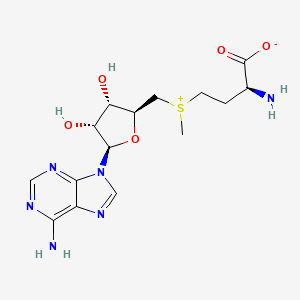
- Formula
- C15H22N6O5S
- Weight
- 398.4 Da
- PubChem CID
- 34755
- Exact Mass
- 398.1372 Da
- LogP
- -2.8
- TPSA
- 186 Ų
- H-Bond Donors
- 4
- H-Bond Acceptors
- 10
- Rotatable Bonds
- 6
- Complexity
- 527
Identifiers (SMILES, InChI)
InChI=1S/C15H22N6O5S/c1-27(3-2-7(16)15(24)25)4-8-10(22)11(23)14(26-8)21-6-20-9-12(17)18-5-19-13(9)21/h5-8,10-11,14,22-23H,2-4,16H2,1H3,(H2-,17,18,19,24,25)/t7-,8+,10+,11+,14+,27?/m0/s1
MEFKEPWMEQBLKI-AIRLBKTGSA-NReferences (7)
- [5]S-Adenosylmethionine (SAMe) for Liver Health: A Systematic Review
→ Systematic review of 15 high-quality studies found SAMe effective in improving liver-related parameters with few adverse events, primarily mild gastrointestinal complaints.
- [2]S-Adenosylmethionine (SAMe) in major depressive disorder (MDD): a clinician-oriented systematic review
→ Systematic review found SAMe showed antidepressant effects in several trials, with some studies showing significant improvement over placebo, though results were mixed when compared to other antidepressants.
- [3]Adjunctive S-adenosylmethionine (SAMe) in treating non-remittent major depressive disorder: An 8-week double-blind, randomized, controlled trial
→ Study of 107 patients found no significant difference between 800mg/day SAMe and placebo as adjunctive treatment for depression, with both groups showing 50%+ response rates due to high placebo response.
- [4]Safety and efficacy of S-adenosylmethionine (SAMe) for osteoarthritis
→ Meta-analysis found SAMe was more effective than placebo in reducing functional limitation in osteoarthritis patients and appeared comparable to NSAIDs for pain relief, with fewer adverse effects.
- [6]S-adenosylmethionine and depression
→ Review of clinical studies found SAMe safe and effective in treating mild and moderate depression, with potential as complementary or alternative therapy to traditional antidepressants.
- [1]Efficacy of a food supplement based on S-adenosyl methionine and probiotic strains in subjects with subthreshold depression and mild-to-moderate depression: A monocentric, randomized, cross-over, double-blind, placebo-controlled clinical trial
→ A combination of SAMe (200mg/day) and probiotics significantly reduced depression symptoms on both HAM-D and PHQ-9 scales compared to placebo in subjects with subthreshold and mild-to-moderate depression over three months.
- [7]Papakostas GI, Mischoulon D, Shyu I, Alpert JE, Fava M S-adenosyl methionine (SAMe) augmentation of serotonin reuptake inhibitors for antidepressant nonresponders with major depressive disorder: a double-blind, randomized clinical trial American Journal of Psychiatry (2010)
→ SAMe titrated to 800 mg twice daily (1600 mg/day) added to SSRIs improved response and remission versus placebo in major depression.
Continue researching SAMe
Keep scientific evidence separate from commercial availability. Review how claims are evaluated, explore question-led research paths, or inspect disclosed source records without changing the editorial conclusions on this page.