Citrulline (L-Citrulline)
L-Citrulline is a non-essential amino acid naturally produced in the body and found in watermelon that serves as a precursor to L-arginine and nitric oxide. It is widely used to support cardiovascular health, enhance exercise performance, and improve blood flow.
Evidence-led profile
Research snapshot
- Evidence stage
- Emerging research
- References
- 4 linked sources
- Research coverage
- 1 area
- Editorial review
- Mar 8, 2026
Published by the PepGuide Editorial Team using our research methodology.
Overview
L-Citrulline is a non-essential amino acid named after Citrullus lanatus, the Latin name for watermelon, from which it was first isolated in 1914. In the body, citrulline participates in the urea cycle, where it is converted to L-arginine by the enzyme argininosuccinate synthetase. This conversion makes citrulline a more effective strategy for raising plasma arginine levels than supplementing with arginine directly, as oral arginine is subject to significant first-pass metabolism in the liver and intestines.
The primary mechanism of action involves the arginine-nitric oxide pathway. By elevating arginine availability, citrulline increases the production of nitric oxide (NO), a potent vasodilator that relaxes blood vessel walls and improves circulation. This has made it a popular supplement among athletes seeking to enhance exercise performance, reduce fatigue, and improve recovery. Clinical studies have shown that citrulline supplementation can reduce muscle soreness, increase time to exhaustion during high-intensity exercise, and improve markers of aerobic performance.
Beyond exercise applications, L-citrulline has been investigated for its cardiovascular benefits, including reduction of blood pressure in both normotensive and hypertensive individuals. Research also suggests potential applications in erectile dysfunction, sickle cell disease, and conditions involving endothelial dysfunction. Typical supplemental doses range from 3–6 g per day of free-form L-citrulline, and it is generally well-tolerated with minimal side effects.
Research
Reported Effects
Exercise Performance:: Highly effective for increasing 'pump' and time to exhaustion, particularly when taken as Citrulline Malate.. Erectile Quality:: Frequently cited as a natural alternative or adjunct to ED medications like Cialis for improving hardness and sensitivity.. Circulatory Issues:: Users report success using it to manage symptoms of Raynaud’s disease by forcing capillary perfusion.. Consistency:: While some notice immediate effects on 'morning wood,' others suggest it takes daily use to reach full ergogenic potential.
Safety and Limitations
Safety Profile: L-Citrulline
Overview L-Citrulline is a non-essential amino acid naturally produced in the body and found in foods such as watermelon. It is converted to L-arginine in the kidneys, subsequently increasing nitric oxide production. It has a well-established safety profile at typical supplemental doses with extensive research backing.
Common Side Effects
- Mild gastrointestinal discomfort including stomach upset, bloating, and nausea
- Heartburn or acid reflux, particularly at higher doses
- Mild headache related to increased nitric oxide and vasodilation
- Occasional changes in stool consistency
Serious Adverse Effects
- Clinically significant adverse effects are rare at standard doses (3-6 g/day)
- Excessive vasodilation may cause symptomatic hypotension in susceptible individuals
- Doses up to 15 g/day have been studied without major adverse effects in short-term trials
- No hepatotoxicity or nephrotoxicity reported at standard supplemental doses
Contraindications
- Known hypersensitivity to L-citrulline or related amino acids
- Citrullinemia and other urea cycle disorders (may worsen metabolic imbalance)
- Active hypotension or conditions requiring strict blood pressure control
- Caution in pregnancy and breastfeeding due to insufficient long-term safety data
Drug Interactions
- Phosphodiesterase-5 inhibitors (sildenafil, tadalafil): additive hypotensive effects through combined nitric oxide pathway stimulation
- Antihypertensive medications: may enhance blood pressure-lowering effects, requiring dose monitoring
- Nitrates (nitroglycerin, isosorbide): potentially dangerous additive vasodilation
- Anticoagulants and antiplatelet agents: theoretical increased bleeding risk due to nitric oxide effects on platelet aggregation
Special Populations
- Renal impairment patients should use with caution as the kidney is the primary conversion site for citrulline to arginine
- Generally well-tolerated in elderly populations but blood pressure monitoring is advised
- Athletes commonly use 6-8 g/day pre-exercise with good tolerability
Dosage Considerations
- General supplementation: 3-6 g/day is well-established as safe
- Citrulline malate form typically dosed at 6-8 g/day
- Split dosing may reduce gastrointestinal side effects
Common Side Effects
- Herpes/Shingles Flare-ups:: Arginine and Citrulline can fuel viral replication, leading to painful shingles or cold sore recurrences.
- Hypotension:: Large doses (3,000mg+) may cause a temporary drop in blood pressure, leading to lightheadedness or fatigue.
- Gastrointestinal Distress:: Higher doses, particularly in malate form, can cause mild stomach upset or diarrhea in sensitive individuals.
- Dental Health:: Bulk powder forms are acidic and may be harmful to tooth enamel if not rinsed properly.
Mechanism of Action
Non-Proteinogenic Amino Acid — Urea Cycle Intermediate
L-Citrulline is a non-proteinogenic alpha-amino acid and key intermediate in the hepatic urea cycle, named after Citrullus lanatus (watermelon) from which it was first isolated. Unlike L-arginine, citrulline bypasses hepatic first-pass extraction by arginase and is not significantly taken up by the liver. Instead, it enters the intestinal-renal axis: dietary citrulline is absorbed intact from the small intestine, transported to the kidneys, and converted to L-arginine by the sequential action of argininosuccinate synthase (ASS1) and argininosuccinate lyase (ASL) in renal proximal tubular cells. This renal conversion provides approximately 60-80% of circulating arginine in adults (PMID: 18056759).
Nitric Oxide Synthase — Arginine-Citrulline Recycling
L-Arginine derived from citrulline serves as the exclusive substrate for nitric oxide synthase (NOS) isoforms (eNOS, nNOS, iNOS), which oxidize the guanidinium group to produce nitric oxide (NO) and regenerate citrulline in a stoichiometric 1:1 ratio. This arginine-citrulline recycling pathway, catalyzed by ASS1 and ASL co-localized with NOS at the plasma membrane (forming the citrulline-NO cycle), sustains NO production even when extracellular arginine is limiting. Citrulline supplementation (3-6 g/day) increases plasma arginine by 50-100%, enhancing endothelial NO production, vasodilation, and reducing systolic blood pressure by 4-9 mmHg (PMID: 20499249).
Exercise Performance & Ammonia Detoxification
Citrulline enhances urea cycle flux, accelerating ammonia detoxification during high-intensity exercise. It also stimulates hepatic gluconeogenesis and renal bicarbonate reabsorption, buffering exercise-induced metabolic acidosis. The enhanced NO production improves muscle oxygen delivery through vasodilation and increases mitochondrial efficiency by reducing the oxygen cost of ATP production (PMID: 21195829).
Protein Synthesis & mTORC1 Activation
Citrulline directly stimulates muscle protein synthesis through mTORC1 signaling, independently of its conversion to arginine, by activating the GCN2/ATF4 amino acid sensing pathway and enhancing nitrogen balance during catabolic states (PMID: 28627917).
Molecular Structure
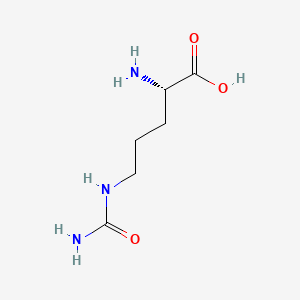
- Formula
- C6H13N3O3
- Weight
- 175.19 Da
- PubChem CID
- 9750
- Exact Mass
- 175.0957 Da
- LogP
- -4.3
- TPSA
- 118 Ų
- H-Bond Donors
- 4
- H-Bond Acceptors
- 4
- Rotatable Bonds
- 5
- Complexity
- 171
Identifiers (SMILES, InChI)
InChI=1S/C6H13N3O3/c7-4(5(10)11)2-1-3-9-6(8)12/h4H,1-3,7H2,(H,10,11)(H3,8,9,12)/t4-/m0/s1
RHGKLRLOHDJJDR-BYPYZUCNSA-NReferences (4)
- [3]A critical review of citrulline malate supplementation and exercise performance
→ This review analyzes the specific benefits of the malate form in improving metabolic efficiency during resistance training and aerobic exercise.
- [1]Ergogenic effects of a 10-day L-citrulline supplementation on time to exhaustion and cardiorespiratory and metabolic responses in healthy individuals
→ A 10-day supplementation protocol of 100 mg/kg per day was found to improve time to exhaustion and oxygen uptake during high-intensity exercise in healthy adults.
- [4]Oral L-citrulline supplementation improves erection hardness in men with mild erectile dysfunction
→ Short-term supplementation was shown to be safe and psychologically well-accepted, significantly improving erection hardness scores in men with mild ED.
- [2]Effects of Citrulline Supplementation on Exercise Performance in Humans: A Review of the Current Literature
→ A comprehensive review indicating that citrulline supplementation can enhance high-intensity strength and power performance while reducing muscle soreness.
Continue researching Citrulline (L-Citrulline)
Keep scientific evidence separate from commercial availability. Review how claims are evaluated, explore question-led research paths, or inspect disclosed source records without changing the editorial conclusions on this page.