Citrulline Malate
Citrulline malate is a compound combining L-citrulline with malic acid, designed to enhance both nitric oxide production and aerobic energy metabolism. It is one of the most popular ergogenic supplements for improving exercise performance, reducing fatigue, and accelerating recovery.
Evidence-led profile
Research snapshot
- Evidence stage
- Emerging research
- References
- 8 linked sources
- Research coverage
- 1 area
- Editorial review
- Mar 8, 2026
Published by the PepGuide Editorial Team using our research methodology.
Overview
Citrulline malate is a salt formed by combining L-citrulline with malic acid, typically in a 2:1 ratio. This combination was originally developed to address fatigue and asthenia in clinical settings, and it has since become one of the most widely used pre-workout supplements in sports nutrition. The rationale for combining these two compounds is that citrulline supports nitric oxide production and ammonia clearance through the urea cycle, while malate participates in the tricarboxylic acid (TCA) cycle to support aerobic ATP generation.
Research on citrulline malate has shown benefits for both resistance and endurance exercise. A frequently cited study demonstrated that 8 g of citrulline malate taken before resistance training significantly increased the number of repetitions performed and reduced post-exercise muscle soreness by up to 40%. The supplement appears to enhance performance by improving ammonia recycling, supporting oxidative ATP production, and increasing blood flow to working muscles through nitric oxide-mediated vasodilation.
The standard recommended dose is 6–8 g of citrulline malate (2:1 ratio) taken approximately 30–60 minutes before exercise. It is important to verify the ratio when selecting products, as some formulations provide a 1:1 ratio, which delivers less active citrulline per serving. Citrulline malate is generally well-tolerated, with gastrointestinal discomfort being the most commonly reported side effect at higher doses. It is often stacked with beta-alanine and creatine in comprehensive pre-workout formulations.
Research
Reported Effects
Training Status Matters:: Research suggests benefits may be more pronounced in trained individuals compared to untrained subjects, though results remain inconsistent. Individual Variability:: User experiences show high individual variation in response, with some reporting significant benefits while others notice no difference from placebo. Dose-Dependent Effects:: Meta-analyses indicate that proper dosing (typically 8g+ of actual citrulline malate) is critical for performance benefits. Quality Control Issues:: Recent research reveals significant problems with manufacturer-stated citrulline:malate ratios, potentially explaining inconsistent results across studies and user experiences
Safety and Limitations
Safety Profile: Citrulline Malate
Common Side Effects
- Gastrointestinal discomfort: the most frequent complaint—stomach upset, mild nausea, heartburn, and diarrhea, primarily attributed to the malic acid component
- Bloating and flatulence, especially at doses above 6 g/day
- Mild headache (possibly related to nitric oxide–mediated vasodilation)
- Altered urine odor (harmless)
Serious Adverse Effects
- Hypotension: citrulline is converted to arginine, which increases nitric oxide production; in individuals on antihypertensives or PDE5 inhibitors, clinically significant blood pressure drops may occur
- Hyperargininemia risk: in rare genetic arginine metabolism disorders (arginase deficiency), citrulline supplementation could exacerbate arginine accumulation and neurotoxicity
- Renal considerations: while generally safe for healthy kidneys, high-dose citrulline increases the nitrogen load; theoretical concern in advanced CKD
- No organ toxicity has been observed in clinical trials at doses up to 15 g/day for short durations
Contraindications
- Known allergy to citrulline or malic acid
- Arginase deficiency or other urea cycle disorders
- Concurrent use of nitrates (nitroglycerin) or PDE5 inhibitors (sildenafil, tadalafil)—risk of severe hypotension
- Severe hypotension (systolic <90 mmHg)
Drug Interactions
- PDE5 inhibitors (sildenafil, tadalafil, vardenafil): significantly amplified vasodilation and hypotensive risk—avoid concurrent use without medical clearance
- Antihypertensives (ACE inhibitors, ARBs, calcium channel blockers): additive blood pressure reduction; monitor BP when initiating citrulline
- Nitrate medications (isosorbide, nitroglycerin): dangerous hypotension possible via shared NO pathway
- Arginine supplements: redundant—citrulline is converted to arginine; stacking increases GI side effects without proportional benefit
- Anticoagulants: some in vitro evidence of mild antiplatelet activity; clinical significance is low but worth noting
Population-Specific Considerations
- Athletes / exercise performance: best-studied population; 6–8 g citrulline malate (2:1 ratio) taken 40–60 minutes pre-workout is well-tolerated; GI issues are the main limiting factor
- Heart failure patients: promising for improving exercise tolerance; 3 g/day showed benefit in pilot studies; use under cardiologist supervision due to hemodynamic effects
- Pregnancy / lactation: no safety data for supplemental doses; L-citrulline is a normal amino acid in watermelon and diet, but concentrated supplements should be avoided
- Elderly: may benefit vascular health; start at 3 g/day; monitor blood pressure
- Kidney disease: mild-moderate CKD—limited data; consult nephrologist before use; avoid in dialysis patients
- Children: no established dosing; some research in sickle cell disease pediatric populations but not standard practice
Common Side Effects
- Gastrointestinal Distress:: Most commonly reported side effect includes stomach upset, bloating, or diarrhea, particularly at higher doses or in sensitive individuals
- Minimal Serious Effects:: Generally well-tolerated with few serious adverse effects reported in research or user experiences
- Taste Issues:: Users frequently mention unpleasant taste when using unflavored powder forms
- Individual Tolerance:: Some individuals report no side effects even at high doses, while others experience GI issues at standard dosing
Mechanism of Action
Dual-Action Ergogenic — Citrulline + TCA Cycle Anaplerosis
Citrulline malate is a 1:1 or 2:1 molar combination of L-citrulline and DL-malic acid (malate), designed to synergistically enhance exercise performance through complementary metabolic pathways. The citrulline component sustains nitric oxide production via the renal arginine-citrulline recycling pathway, while the malate component provides a tricarboxylic acid (TCA) cycle anaplerotic substrate that replenishes oxaloacetate (OAA) through the malate-aspartate shuttle, maintaining aerobic ATP production when TCA intermediates are depleted during high-intensity exercise (PMID: 12145119).
Malate Dehydrogenase & Aerobic Energy Production
Malate enters the mitochondrial matrix via the dicarboxylate carrier and is oxidized to oxaloacetate by malate dehydrogenase (MDH2), generating NADH that feeds complex I of the electron transport chain. OAA then condenses with acetyl-CoA (from fatty acid oxidation and pyruvate dehydrogenase) via citrate synthase, sustaining TCA cycle flux. During intense exercise, TCA intermediates are depleted through cataplerotic reactions (glutamate transamination, amino acid synthesis), and malate supplementation restores the OAA pool, preventing the metabolic bottleneck that limits aerobic ATP regeneration (PMID: 21799861).
Ammonia Clearance & Acid-Base Balance
The combined citrulline-malate formulation accelerates ammonia detoxification through enhanced urea cycle flux (citrulline-mediated) and improved hepatic gluconeogenesis from lactate (malate-mediated). Citrulline malate reduces blood ammonia levels by 15-30% during exhaustive exercise, attenuating central fatigue mediated by ammonia-induced glutamine accumulation in astrocytes. The malate component also participates in the malate-aspartate shuttle, transferring cytoplasmic NADH equivalents into mitochondria for oxidative phosphorylation (PMID: 20386132).
Clinical Exercise Performance Evidence
A landmark study by Bendahan et al. demonstrated that 6 g citrulline malate daily increased oxidative ATP production by 34%, reduced phosphocreatine recovery time by 20%, and increased total work output during repeated high-intensity cycling bouts, supporting its role as an ergogenic aid for resistance and high-intensity interval training (PMID: 12145119).
Research protocol summary
- Typical Dose
- 8g appears to be the most frequently studied and recommended acute dose based on research literature
These values summarize cataloged research protocols. They are not personal dosing instructions or medical guidance.
Molecular Structure
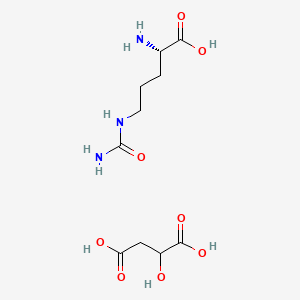
- Formula
- C10H19N3O8
- Weight
- 309.27 Da
- PubChem CID
- 162762
- Exact Mass
- 309.1172 Da
- TPSA
- 213 Ų
- H-Bond Donors
- 7
- H-Bond Acceptors
- 9
- Rotatable Bonds
- 8
- Complexity
- 300
Identifiers (SMILES, InChI)
InChI=1S/C6H13N3O3.C4H6O5/c7-4(5(10)11)2-1-3-9-6(8)12;5-2(4(8)9)1-3(6)7/h4H,1-3,7H2,(H,10,11)(H3,8,9,12);2,5H,1H2,(H,6,7)(H,8,9)/t4-;/m0./s1
DROVUXYZTXCEBX-WCCKRBBISA-NReferences (8)
- [1]A critical review of citrulline malate supplementation and exercise performance
→ Review concludes that evidence for CM's effectiveness remains ambiguous due to methodological discrepancies including dosing strategies, quality control issues with citrulline:malate ratios, and varying test protocols. More well-controlled studies with highly repeatable protocols are needed.
- [2]Acute Effect of Citrulline Malate on Repetition Performance During Strength Training: A Systematic Review and Meta-Analysis
→ Meta-analysis of 8 studies with 137 participants found CM supplementation significantly increased total repetitions performed before muscular failure, with benefits observed across multiple upper and lower body exercises.
- [3]Effects of Citrulline Malate Supplementation on Muscle Strength in Resistance-Trained Adults: A Systematic Review and Meta-Analysis
→ Systematic review examining CM's effects on muscle strength variables found unclear and misleading findings in the literature, highlighting the need for better-controlled research to elucidate ergogenic impact.
- [4]Effects of Citrulline Supplementation on Exercise Performance in Humans: A Review of the Current Literature
→ Comprehensive review examining L-citrulline's effects on aerobic and anaerobic performance, vascular function, and potential synergistic effects with other ingredients. Suggests potential ergogenic value but notes need for more research.
- [5]Acute Citrulline-Malate Supplementation and High-Intensity Cycling Performance
→ Double-blind crossover study with 10 well-trained males found 12g CM consumed 60 minutes pre-exercise affected acid-base balance but results on performance improvements were mixed.
- [6]Effects of Acute Citrulline Malate Supplementation on CrossFit Exercise Performance
→ Randomized controlled crossover trial examined CM supplementation effects on CrossFit-specific performance metrics in trained athletes, contributing to literature on sport-specific applications.
- [7]Citrulline Malate Does Not Improve Muscle Recovery after Resistance Exercise in Untrained Young Adult Men
→ Study found that CM supplementation did not significantly improve muscle recovery markers or reduce soreness following resistance exercise in untrained individuals.
- [8]Malate or Not? Acute Effects of L-Citrulline Versus Citrulline Malate on Neuromuscular Performance
→ Double-blind crossover trial with 43 trained adults compared pure L-citrulline versus citrulline malate to determine whether malate provides additive ergogenic effects when combined with citrulline.
Continue researching Citrulline Malate
Keep scientific evidence separate from commercial availability. Review how claims are evaluated, explore question-led research paths, or inspect disclosed source records without changing the editorial conclusions on this page.