Tripeptide-10 Citrulline
Tripeptide-10 Citrulline (Decorinyl) is a Lipotec-developed peptide that stimulates decorin production to regulate collagen fibrillogenesis, improving extracellular matrix organization and reducing wrinkle depth.
Evidence-led profile
Research snapshot
- Evidence stage
- Emerging research
- References
- 7 linked sources
- Research coverage
- 3 areas
- Editorial review
- Jul 7, 2026
Published by the PepGuide Editorial Team using our research methodology.
Overview
Decorin is a proteoglycan that binds to collagen fibrils and regulates their diameter, spacing, and lateral association during fibrillogenesis. In young skin, decorin ensures that collagen fibers form organized, regularly spaced bundles that provide optimal mechanical strength and flexibility. With aging, decorin levels decline, leading to disorganized collagen architecture -- fibers become irregularly packed, variable in diameter, and poorly aligned. This structural deterioration contributes to skin wrinkling and loss of firmness even in skin that retains adequate total collagen content.
Tripeptide-10 Citrulline was designed to address this overlooked aspect of skin aging. The peptide sequence mimics a fragment of decorin's collagen-binding domain, and the citrulline residue enhances the peptide's stability and biological activity. By upregulating decorin expression in fibroblasts, Decorinyl promotes the formation of properly organized collagen fiber networks.
Clinical studies have shown that topical application of Decorinyl reduces wrinkle depth and improves skin smoothness, with the improvements attributed to enhanced collagen fiber organization rather than increased collagen mass. The peptide is typically used at 2-5% in finished cosmetic formulations.
Research
Decorin Expression and Collagen Organization
In vitro studies demonstrated that Tripeptide-10 Citrulline significantly increases decorin mRNA and protein levels in cultured human dermal fibroblasts. Confocal microscopy of three-dimensional skin models showed that treated samples exhibited more regularly organized collagen fiber networks compared to controls, with more uniform fibril diameters and spacing patterns consistent with decorin-mediated fibrillogenesis regulation.
Clinical Wrinkle Reduction
Clinical trials evaluating Decorinyl in topical formulations demonstrated significant reductions in wrinkle depth and roughness parameters over 56-day treatment periods. Profilometric analysis showed improvements in skin surface regularity, consistent with improved dermal collagen organization. The wrinkle reduction achieved by Decorinyl was attributed to improved collagen quality rather than increased quantity, representing a mechanistically distinct approach to anti-wrinkle efficacy.
Complementarity with Collagen-Stimulating Peptides
Decorinyl provides a logical complement to collagen-stimulating peptides such as Matrixyl or Palmitoyl Tripeptide-1. While those peptides increase the total amount of collagen produced, Decorinyl ensures that newly synthesized collagen is assembled into properly organized fibrillar structures. Formulations combining both approaches aim to increase collagen quantity and quality simultaneously.
Safety and Limitations
Tripeptide-10 Citrulline has a favorable safety profile for topical cosmetic use. Dermatological testing including patch testing and repeated insult assays demonstrates no irritation, sensitization, or phototoxicity at recommended use concentrations. The peptide is well-tolerated on sensitive skin and compatible with standard cosmetic formulation ingredients. Systemic absorption from topical application is negligible. No adverse effects have been reported in clinical studies. Citrulline is a naturally occurring amino acid in human metabolism, supporting the peptide's biocompatibility.
Mechanism of Action
Tripeptide-10 Citrulline operates through a dual mechanism. First, it stimulates dermal fibroblasts to increase production of decorin protein. Decorin binds to the surface of collagen fibrils via its leucine-rich repeat domain, controlling fibril diameter by limiting lateral fusion and ensuring uniform spacing between fibrils. This regulation is essential for the formation of organized collagen bundles with optimal biomechanical properties.
Second, the peptide may directly influence collagen fibrillogenesis by mimicking decorin's collagen-binding activity. The citrulline residue -- a post-translationally modified form of arginine -- enhances the peptide's interaction with collagen surfaces and confers resistance to enzymatic degradation by trypsin-like proteases.
The net effect is a reorganization of the dermal collagen network from the disordered state characteristic of aged or photoaged skin toward the organized, uniformly bundled architecture seen in younger skin. This improved organization translates to better light reflection (smoother surface appearance) and enhanced mechanical resilience (improved firmness and reduced wrinkling).
Research protocol summary
- Route
- Topical
These values summarize cataloged research protocols. They are not personal dosing instructions or medical guidance.
Pharmacokinetic Profile
- Half-life
- Not established
Molecular Structure
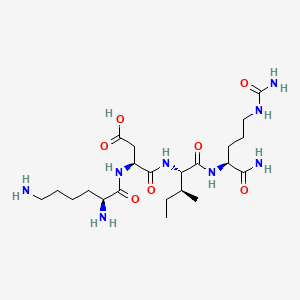
- Formula
- C₂₀H₃₆N₆O₇ (approximate)
- Weight
- 530.6 Da
- CAS
- Not assigned
- PubChem CID
- 90479646
- Exact Mass
- 530.3176 Da
- LogP
- -5.3
- TPSA
- 275 Ų
- H-Bond Donors
- 9
- H-Bond Acceptors
- 9
- Rotatable Bonds
- 19
- Complexity
- 795
Identifiers (SMILES, InChI)
InChI=1S/C22H42N8O7/c1-3-12(2)17(21(36)28-14(18(25)33)8-6-10-27-22(26)37)30-20(35)15(11-16(31)32)29-19(34)13(24)7-4-5-9-23/h12-15,17H,3-11,23-24H2,1-2H3,(H2,25,33)(H,28,36)(H,29,34)(H,30,35)(H,31,32)(H3,26,27,37)/t12-,13-,14-,15-,17-/m0/s1
GKPMARPRXONRJX-BWJWTDLKSA-NResearch Protocols
topical
Clinical studies have shown that topical application of Decorinyl reduces wrinkle depth and improves skin smoothness, with the improvements attributed to enhanced collagen fiber organization rather than increased collagen mass. Clinical Wrinkle Reduction Clinical trials evaluating Decorinyl in topi
Quality Indicators
What to look for
- Well-established safety profile
- Naturally occurring compound
Frequently Asked Questions
References (7)
- [5]
- [6]Gubbiotti MA et al -- Decorin and biglycan: essential regulators of collagen fibrillogenesis Matrix Biology Plus (2023)
- [7]Negari et al -- Peptide-based cosmeceuticals: an evolving field of investigation Int J Mol Sci (2023)
- [2]Lintner K et al Cosmetic peptides Int J Cosmet Sci (2009)
- [1]Iozzo RV, Schaefer L Proteoglycan form and function: a comprehensive nomenclature of proteoglycans Matrix Biology (2015)
- [3]Reed CC, Iozzo RV The role of decorin in collagen fibrillogenesis and skin homeostasis Glycoconj J (2002)
- [7]Errante F, Ledwoń P, Latajka R, Rovero P, Papini AM Cosmeceutical Peptides in the Framework of Sustainable Wellness Economy Frontiers in Chemistry (2020)
→ Describes Tripeptide-10 Citrulline (Decorinyl), a decorin-mimetic peptide that regulates collagen fiber diameter, used topically for skin firmness/rejuvenation.
Continue researching Tripeptide-10 Citrulline
Keep scientific evidence separate from commercial availability. Review how claims are evaluated, explore question-led research paths, or inspect disclosed source records without changing the editorial conclusions on this page.