5-HTP
5-Hydroxytryptophan (5-HTP) is a naturally occurring amino acid and direct precursor to serotonin, commonly supplemented to support mood, sleep, and appetite regulation.
Evidence-led profile
Research snapshot
- Evidence stage
- Emerging research
- References
- 9 linked sources
- Research coverage
- 1 area
- Editorial review
- Mar 8, 2026
Published by the PepGuide Editorial Team using our research methodology.
Overview
5-Hydroxytryptophan (5-HTP) is an intermediate metabolite in the biosynthesis of serotonin from the essential amino acid L-tryptophan. It is produced endogenously by the enzyme tryptophan hydroxylase and is also found naturally in the seeds of the African plant Griffonia simplicifolia. Once ingested, 5-HTP readily crosses the blood-brain barrier and is converted to serotonin (5-hydroxytryptamine) by aromatic L-amino acid decarboxylase, making it a more efficient serotonin precursor than tryptophan itself.
Clinical research has investigated 5-HTP for a range of conditions associated with low serotonin activity, including depression, insomnia, fibromyalgia, migraine headaches, and obesity. Several small trials have reported improvements in depressive symptoms comparable to certain SSRIs, though large-scale, high-quality studies remain limited. Its effects on appetite suppression have been attributed to enhanced serotonergic signaling in hypothalamic satiety centers.
5-HTP is generally well tolerated at typical oral doses of 50-300 mg per day, though gastrointestinal side effects such as nausea and diarrhea can occur. Co-administration with serotonergic medications (SSRIs, MAOIs, triptans) carries a theoretical risk of serotonin syndrome and should be avoided without medical supervision. Long-term supplementation is sometimes paired with a peripheral decarboxylase inhibitor like carbidopa to prevent excessive peripheral serotonin production.
Research
Reported Effects
Variable Response:: Effectiveness varies significantly among individuals, with some experiencing dramatic improvements and others noticing minimal change.. Works Best With Cofactors:: Users report better results when combining with B6 and other cofactors that support serotonin synthesis.
Safety and Limitations
Safety Profile: 5-HTP (5-Hydroxytryptophan)
Common Side Effects
- GI effects (most common): Nausea, vomiting, diarrhea, heartburn, stomach pain — dose-dependent, often significant above 300 mg/day
- CNS effects: Drowsiness, dizziness, headache, vivid dreams
- Other: Decreased appetite (may be therapeutic for weight management), muscle tenderness
Serious Adverse Effects
- Serotonin syndrome: Life-threatening risk when combined with serotonergic drugs — symptoms include agitation, hyperthermia, tachycardia, clonus, diaphoresis
- Eosinophilia-myalgia syndrome (EMS): Historical concern from contaminated L-tryptophan (1989); modern 5-HTP is derived from Griffonia simplicifolia seeds, but contamination risk with "peak X" has been reported in some preparations
- Cardiac valvulopathy: Theoretical concern — 5-HTP raises peripheral serotonin, which is implicated in cardiac valve fibrosis (similar mechanism to fenfluramine); long-term risk not fully characterized
Contraindications
- Concurrent use with MAOIs (absolute contraindication — severe serotonin syndrome risk)
- Concurrent use with SSRIs/SNRIs without medical supervision
- Carcinoid tumors (serotonin-producing tumors)
- Down syndrome (increased sensitivity to serotonergic agents reported)
- Planned surgery (discontinue 2 weeks prior — serotonin affects platelet aggregation)
Drug Interactions
- SSRIs/SNRIs (fluoxetine, sertraline, venlafaxine, duloxetine): HIGH RISK — serotonin syndrome; do not combine without specialist supervision
- MAOIs (phenelzine, tranylcypromine, selegiline): CONTRAINDICATED — severe serotonin syndrome
- Triptans (sumatriptan): Additive serotonergic effects; avoid concurrent use
- Tramadol, meperidine, dextromethorphan: Serotonin syndrome risk
- Carbidopa: Dramatically increases 5-HTP bioavailability (historically used together) but also increases peripheral serotonin and side effects
- St. John's Wort: Additive serotonergic effect; avoid combination
Special Populations
- Pregnancy/Lactation: Contraindicated — serotonin is critical for fetal development; exogenous manipulation may be harmful
- Pediatric: Insufficient safety data; not recommended
- Elderly: Start at low doses (50 mg); increased sensitivity to serotonergic effects and falls risk from drowsiness
- Hepatic/renal impairment: Limited data; 5-HTP is converted peripherally and centrally — use with caution
Monitoring Recommendations
- Monitor for serotonin syndrome symptoms (first 24 hours with new combinations)
- Eosinophil count if unexplained myalgia develops
- Echocardiography consideration with prolonged high-dose use (>6 months at >200 mg/day) given cardiac valvulopathy concern
- Blood pressure and heart rate
- Mood and behavioral monitoring (paradoxical anxiety/agitation possible)
Regulatory Note: 5-HTP is a dietary supplement in the US (not FDA-approved as a drug). It is a prescription medication in some European countries. Quality varies between manufacturers; third-party tested products are preferable.
Common Side Effects
- Digestive Issues:: Nausea and digestive discomfort are common initially but often subside.
- Serotonin Syndrome Risk:: Should not be combined with SSRIs or other serotonergic medications.
- Drowsiness:: May cause drowsiness, particularly at higher doses.
Mechanism of Action
Serotonin Biosynthesis Pathway
5-Hydroxytryptophan (5-HTP) is the immediate biosynthetic precursor to serotonin (5-hydroxytryptamine, 5-HT). Unlike tryptophan, 5-HTP freely crosses the blood-brain barrier without competing for transport with other large neutral amino acids (PMID: 9727088).
Enzymatic Conversion
Once absorbed, 5-HTP is decarboxylated by aromatic L-amino acid decarboxylase (AADC, EC 4.1.1.28) to produce serotonin. This enzyme is present in both CNS serotonergic neurons and peripheral tissues (gut enterochromaffin cells, kidneys). The conversion is rapid and does not require biopterin cofactors, unlike the rate-limiting tryptophan hydroxylase step it bypasses (PMID: 10696570).
Downstream Serotonergic Signaling
Elevated serotonin activates the 5-HT receptor family (5-HT1A, 5-HT2A, 5-HT2C, 5-HT3, 5-HT4, etc.), modulating mood, appetite, sleep-wake cycles, and nociception. In the CNS, increased 5-HT1A autoreceptor activation initially dampens firing rates in dorsal raphe neurons, with desensitization over days leading to sustained serotonergic enhancement.
Melatonin Pathway
Serotonin also serves as a substrate for melatonin synthesis in the pineal gland. Serotonin is acetylated by arylalkylamine N-acetyltransferase (AANAT) to form N-acetylserotonin, then methylated by hydroxyindole O-methyltransferase (HIOMT) to produce melatonin, linking 5-HTP supplementation to circadian rhythm regulation (PMID: 15070165).
Peripheral Effects
Approximately 95% of serotonin resides in the gut, where 5-HTP-derived serotonin modulates GI motility via enteric nervous system 5-HT3 and 5-HT4 receptors. Peripheral conversion can be mitigated by co-administration of carbidopa, a peripheral AADC inhibitor.
Research protocol summary
- Typical Dose
- 50-300mg daily, often taken in divided doses.
These values summarize cataloged research protocols. They are not personal dosing instructions or medical guidance.
Pharmacokinetic Profile
- Half-life
- 3 h
- Tmax
- 1.5 h
Molecular Structure
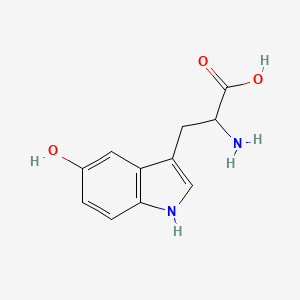
- Formula
- C11H12N2O3
- Weight
- 220.22 Da
- PubChem CID
- 144
- Exact Mass
- 220.0848 Da
- LogP
- -1.2
- TPSA
- 99.3 Ų
- H-Bond Donors
- 4
- H-Bond Acceptors
- 4
- Rotatable Bonds
- 3
- Complexity
- 272
Identifiers (SMILES, InChI)
InChI=1S/C11H12N2O3/c12-9(11(15)16)3-6-5-13-10-2-1-7(14)4-8(6)10/h1-2,4-5,9,13-14H,3,12H2,(H,15,16)
LDCYZAJDBXYCGN-UHFFFAOYSA-NReferences (9)
- [7]Analgesic effects of N-acetyl-5HTP-5HTP amide are not directly related to brain serotonin levels
→ Synthetic 5-HTP dipeptide increased pain thresholds in rats through an alternate pathway independent of serotonin.
- [6]Amines and the rat exocrine pancreas: Effects of receptor blockers on turnover of L-5HTP
→ Research studied 5-HTP metabolism in the pancreas, showing changes in serotonin accumulation with receptor blockers.
- [3]The impact of 5-hydroxytryptophan supplementation on sleep quality and gut microbiota composition in older adults
→ Twelve-week trial demonstrated 5-HTP improved sleep quality and increased microbiota diversity in older adults.
- [8]HVA and 5HIAA CSF measurements and 5HTP trials in some patients with involuntary movements
→ 5-HTP trials showed selective therapeutic benefit in specific myoclonus conditions while worsening symptoms in other movement types.
- [9]Effect of L-5HTP on Tremorine- or Oxotremorine-Induced Tremor in Mice and Rats
→ Study examined 5-HTP's potential for managing tremors and muscle rigidity, relevant to Parkinson's research.
- [2]Tryptophan-enriched diet or 5-hydroxytryptophan supplementation given in a randomized controlled trial impacts social cognition
→ Study found 5-HTP influences social cognition, particularly in interpreting moral and emotional cues, with increased empathy-related brain activity.
- [4]Advances in the Microbial Synthesis of 5-Hydroxytryptophan
→ Review discussing recent advancements in microbial methods for 5-HTP production, improving biosynthesis efficiency.
- [1]5-Hydroxytryptophan (5-HTP): Natural Occurrence, Analysis, Biosynthesis, Biotechnology, Physiology and Toxicology
→ Comprehensive review covering 5-HTP's role in neurological and metabolic health, discussing its production and uses in treating depression and anxiety.
- [5]Simultaneous determination of 5-hydroxytryptophan and 3-O-methyldopa in dried blood spot by UPLC-MS/MS
→ Study developed a diagnostic method to measure 5-HTP, aiding detection of L-amino acid decarboxylase deficiency.
Continue researching 5-HTP
Keep scientific evidence separate from commercial availability. Review how claims are evaluated, explore question-led research paths, or inspect disclosed source records without changing the editorial conclusions on this page.