Carnosine
Carnosine is a naturally occurring dipeptide composed of beta-alanine and histidine, found in high concentrations in skeletal muscle and brain tissue. It functions as an intracellular buffer, antioxidant, and anti-glycation agent.
Evidence-led profile
Research snapshot
- Evidence stage
- Emerging research
- References
- 9 linked sources
- Research coverage
- 1 area
- Editorial review
- Mar 8, 2026
Published by the PepGuide Editorial Team using our research methodology.
Overview
Carnosine (beta-alanyl-L-histidine) is a dipeptide synthesized endogenously from beta-alanine and L-histidine by the enzyme carnosine synthase. It is found in high concentrations in skeletal muscle, cardiac muscle, and certain brain regions, with tissue levels that decline progressively with age. Dietary sources include red meat and poultry, while vegetarians typically exhibit lower muscle carnosine levels.
One of the best-characterized functions of carnosine is its role as an intracellular pH buffer in skeletal muscle. During high-intensity exercise, carnosine helps neutralize hydrogen ions generated by anaerobic glycolysis, delaying the onset of muscular fatigue. This buffering capacity has made beta-alanine supplementation — which increases muscle carnosine concentrations — one of the most evidence-based ergogenic aids in sports nutrition, endorsed by the International Society of Sports Nutrition.
Beyond its buffering role, carnosine demonstrates significant anti-glycation properties, inhibiting the formation of advanced glycation end products (AGEs) that contribute to aging, diabetic complications, and neurodegenerative disease. It also acts as a direct scavenger of reactive oxygen species and reactive aldehydes, including malondialdehyde and methylglyoxal. Research has explored carnosine's potential therapeutic applications in diabetic nephropathy, cognitive decline, and wound healing, with several clinical trials underway to evaluate its efficacy in human populations.
Research
Reported Effects
High-Intensity Exercise:: Most effective for exercises lasting 60-240 seconds and repeated high-intensity bouts; benefits are well-established in research and confirmed by athletes and fitness enthusiasts. Gut Restoration:: Zinc-carnosine form shows particularly high effectiveness for healing stomach lining, reducing inflammation, and managing H. pylori, with users reporting dramatic improvements within weeks. Individual Variation:: Effectiveness varies significantly by individual, with some users experiencing immediate benefits while others notice no effects; baseline carnosine levels and specific health conditions influence outcomes. Chronic Loading Required:: Beta-alanine requires 2-4 weeks of consistent supplementation to increase muscle carnosine levels sufficiently; acute dosing is ineffective, requiring patience for results to manifest
Safety and Limitations
Common Side Effects
- Generally very well-tolerated at standard supplemental doses (500-2,000 mg daily)
- Mild gastrointestinal symptoms including nausea, stomach discomfort, and diarrhea are occasionally reported
- Mild headache reported by some users during initial supplementation
- Transient tingling or paresthesia at higher doses, similar to beta-alanine (carnosine is composed of beta-alanine and histidine)
Serious Adverse Effects
- No significant serious adverse effects have been documented at standard oral supplementation doses in available clinical literature
- Carnosine is rapidly broken down by the enzyme carnosinase in human blood, which limits systemic exposure and likely contributes to its favorable safety profile
- Very rare cases of allergic reaction have been reported
- Theoretical concerns about histamine release (histidine is a carnosine component and histamine precursor), though clinically significant histamine elevation from oral carnosine supplementation has not been demonstrated
Contraindications
- Individuals with histamine intolerance or mast cell disorders should use with caution due to the histidine component, which can be converted to histamine
- Those with carnosinase deficiency (carnosinemia), a rare genetic condition, should avoid supplementation as they cannot properly metabolize carnosine
- No other absolute contraindications have been established
Drug Interactions
- May have additive blood pressure-lowering effects when combined with antihypertensive medications, as carnosine has demonstrated ACE-inhibitory properties in some studies
- Potential interaction with antidiabetic medications due to carnosine's effects on glycation and blood glucose regulation; blood sugar monitoring is advisable
- Theoretical interaction with antihistamine medications, though clinical significance is unclear
- No well-documented major drug interactions at standard supplement doses
- May theoretically enhance the effects of other antioxidant supplements (alpha-lipoic acid, vitamin E) through complementary mechanisms
Special Populations
- Safety during pregnancy and breastfeeding has not been formally evaluated; supplementation is not recommended due to lack of data
- Pediatric safety data is limited; carnosine has been studied in children with autism spectrum disorder at doses of 400-800 mg daily with acceptable tolerability in small trials
- Generally well-tolerated in elderly populations, where carnosine levels naturally decline; most clinical studies in older adults have shown good safety profiles
- Vegetarians and vegans may have lower baseline carnosine levels (as dietary carnosine comes primarily from meat) and may benefit from supplementation
Common Side Effects
- Paresthesia (Tingling):: Beta-alanine commonly causes harmless tingling sensations in face, neck, and hands at higher doses; users report this is dose-dependent and can be minimized by dividing doses or using sustained-release formulations
- Taurine Depletion:: Some research suggests beta-alanine may deplete taurine levels due to competition for transporters; users concerned about this may co-supplement with taurine
- Digestive Effects:: Some users report mild GI upset with zinc-carnosine or carnosine, though this is less common than with other supplements; taking with small amounts of food may help
- Minimal Long-Term Concerns:: Research indicates beta-alanine and carnosine are generally safe for long-term use with few serious side effects reported in clinical trials or user experiences
Mechanism of Action
Dipeptide Antioxidant & Metal Chelator
Carnosine (beta-alanyl-L-histidine) is an endogenous dipeptide found at millimolar concentrations in skeletal muscle, cardiac muscle, and brain tissue. Its imidazole ring (from histidine) confers potent metal ion chelation (Cu2+, Zn2+, Fe2+), preventing Fenton reaction-mediated hydroxyl radical generation. Carnosine directly scavenges reactive oxygen species (ROS) and reactive nitrogen species (RNS), including superoxide, hydroxyl radicals, singlet oxygen, and peroxynitrite. It also quenches reactive carbonyl species (RCS) — methylglyoxal, glyoxal, and hydroxynonenal (HNE) — through nucleophilic adduct formation at its amino group, preventing advanced glycation end-product (AGE) and advanced lipoxidation end-product (ALE) formation (PMID: 15992683).
Intracellular pH Buffering
Carnosine functions as a physicochemical pH buffer in tissues with high glycolytic rates, particularly fast-twitch (type II) skeletal muscle fibers. Its imidazole moiety has a pKa of 6.83, ideally positioned to buffer H+ ions in the physiological pH range (6.5-7.1) during intense exercise. Carnosine contributes approximately 10-20% of total intracellular buffering capacity in human muscle, attenuating the acidosis-mediated decline in calcium sensitivity of contractile proteins and maintaining phosphofructokinase activity during high-intensity exercise (PMID: 20091069).
Anti-Glycation & AGE Inhibition
Carnosine inhibits protein glycation through two mechanisms: (1) direct scavenging of reactive aldehydes (methylglyoxal, glyoxal) before they can modify lysine and arginine residues on proteins, and (2) competitive binding to protein carbonyl groups, acting as a sacrificial nucleophile that forms carnosine-carbonyl adducts excreted renally. This anti-glycation activity protects against diabetic complications including nephropathy, retinopathy, and neuropathy by preserving protein structure and function (PMID: 16804013).
Neuroprotective & Anti-Excitotoxic Effects
In the CNS, carnosine modulates glutamatergic neurotransmission by chelating zinc released from glutamatergic synaptic vesicles, preventing zinc-mediated potentiation of NMDA receptors and excitotoxic neuronal death. Carnosine also upregulates expression of brain-derived neurotrophic factor (BDNF) and activates the Nrf2/ARE pathway, enhancing antioxidant defenses in astrocytes and neurons (PMID: 19915012).
Pharmacokinetic Profile
- Half-life
- 0.5 h
- Tmax
- 1 h
Molecular Structure
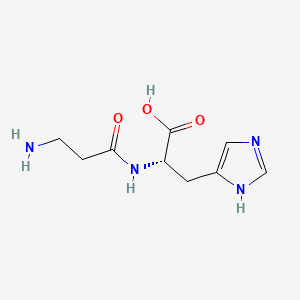
- Formula
- C9H14N4O3
- Weight
- 226.23 Da
- PubChem CID
- 439224
- Exact Mass
- 226.1066 Da
- LogP
- -4
- TPSA
- 121 Ų
- H-Bond Donors
- 4
- H-Bond Acceptors
- 5
- Rotatable Bonds
- 6
- Complexity
- 259
Identifiers (SMILES, InChI)
InChI=1S/C9H14N4O3/c10-2-1-8(14)13-7(9(15)16)3-6-4-11-5-12-6/h4-5,7H,1-3,10H2,(H,11,12)(H,13,14)(H,15,16)/t7-/m0/s1
CQOVPNPJLQNMDC-ZETCQYMHSA-NReferences (9)
- [4]International society of sports nutrition position stand: Beta-Alanine
→ Official position statement confirming beta-alanine supplementation increases muscle carnosine levels and improves performance in high-intensity exercise, particularly exercises lasting 60-240 seconds.
- [7]The Effect of β-Alanine Supplementation on Performance, Cognitive Function and Resiliency in Soldiers
→ Evidence suggests beta-alanine supplementation increases carnosine in the brain and may enhance resilience to post-traumatic stress disorder, mild traumatic brain injury, and heat stress, though cognitive benefits require more research.
- [1]Carnosine and Beta-Alanine Supplementation in Human Medicine: Narrative Review and Critical Assessment
→ Comprehensive review showing carnosine and its precursor beta-alanine have wide-ranging effects including anti-inflammatory, antioxidant, antiglycation, and immunomodulatory properties with applications across multiple areas of human medicine.
- [2]Role of beta-alanine supplementation on muscle carnosine and exercise performance
→ Beta-alanine supplementation increases muscle carnosine content and total muscle buffer capacity, improving performance during high-intensity exercise lasting more than 60 seconds and delaying onset of neuromuscular fatigue.
- [3]β-alanine supplementation to improve exercise capacity and performance: a systematic review and meta-analysis
→ Systematic review and meta-analysis confirming beta-alanine supplementation improves exercise capacity and performance, with effects modeled using advanced statistical methods accounting for data dependencies.
- [6]Zinc carnosine: Frontiers advances of supplement for cancer therapy
→ Review examining zinc-carnosine's role in cancer therapy, discussing zinc's importance in brain function and evidence that zinc metabolic imbalance contributes to various diseases including cancer.
- [8]Carnosine Supplementation Has No Effect on Inflammatory Markers in Adults with Prediabetes and Type 2 Diabetes
→ Randomized controlled trial found that carnosine supplementation did not significantly affect inflammatory markers in adults with prediabetes and type 2 diabetes, despite theoretical anti-inflammatory properties.
- [9]Histidine in Health and Disease: Metabolism, Physiological Importance, and Use as a Supplement
→ Histidine is essential for carnosine synthesis and has unique roles in proton buffering, metal chelation, and antioxidant activity, with histidine-containing dipeptides like carnosine serving specific physiological functions.
- [5]A Patented Dietary Supplement (Hydroxy-Methyl-Butyrate, Carnosine, Magnesium, Butyrate, Lactoferrin) Is a Promising Therapeutic Target for Age-Related Sarcopenia
→ Randomized controlled trial showing a supplement combination including carnosine improved muscle mass and function in sarcopenia through regulation of gut permeability and anti-inflammatory effects.
Continue researching Carnosine
Keep scientific evidence separate from commercial availability. Review how claims are evaluated, explore question-led research paths, or inspect disclosed source records without changing the editorial conclusions on this page.