CoQ10 (Coenzyme Q10)
Coenzyme Q10 (CoQ10) is a fat-soluble quinone compound essential for mitochondrial electron transport and cellular energy production. It also functions as a powerful lipid-soluble antioxidant and is widely supplemented for cardiovascular health, energy support, and mitigation of statin-related side effects.
Evidence-led profile
Research snapshot
- Evidence stage
- Emerging research
- References
- 9 linked sources
- Research coverage
- 1 area
- Editorial review
- Mar 8, 2026
Published by the PepGuide Editorial Team using our research methodology.
Overview
Coenzyme Q10, also known as ubiquinone (oxidized form) or ubiquinol (reduced form), is a naturally occurring fat-soluble compound found in virtually every cell of the body, with the highest concentrations in organs with high metabolic demands such as the heart, liver, kidneys, and pancreas. It plays an indispensable role in the mitochondrial electron transport chain, where it shuttles electrons between Complex I/II and Complex III during oxidative phosphorylation, directly supporting the production of adenosine triphosphate (ATP). In its reduced form (ubiquinol), CoQ10 also serves as one of the body's most important lipid-soluble antioxidants, protecting cell membranes and lipoproteins from oxidative damage.
The cardiovascular applications of CoQ10 are the most extensively studied. The landmark Q-SYMBIO trial demonstrated that CoQ10 supplementation at 300 mg per day significantly reduced major adverse cardiovascular events and all-cause mortality in patients with chronic heart failure. CoQ10 is also widely recommended to address the myalgia and muscle dysfunction associated with statin therapy, as statins inhibit the mevalonate pathway that produces both cholesterol and CoQ10. Additional cardiovascular benefits include modest reductions in blood pressure and improvements in endothelial function. Research also suggests potential applications in migraine prevention, neurodegenerative diseases, male fertility, and exercise performance.
CoQ10 is available in two supplemental forms: ubiquinone and ubiquinol. Ubiquinol is the active, reduced form and generally demonstrates superior bioavailability, particularly in older adults whose ability to convert ubiquinone to ubiquinol may be diminished. Typical supplemental doses range from 100–300 mg per day, taken with a fat-containing meal to enhance absorption. Endogenous CoQ10 production declines with age, beginning around age 30, which provides a physiological rationale for supplementation in middle-aged and older adults. CoQ10 has an excellent safety profile, with no serious adverse effects reported at doses up to 1,200 mg per day in clinical trials.
Research
Reported Effects
Dosage Matters:: Most effective results reported at 300-400mg daily, with users noting that lower doses may not produce noticeable effects; ubiquinol form noted as more bioavailable though more expensive. Timeline for Results:: Users typically report feeling effects within 2 weeks to 2 months, with skin, energy, and mood improvements becoming noticeable after consistent daily use. Synergistic Benefits:: CoQ10 appears most effective when combined with other mitochondrial supporters (PQQ 40mg, NAD, magnesium glycinate) rather than as standalone supplement. Quality Concerns:: Independent testing revealed 0 of 10 CoQ10 products met label claims, with 6 having less than 5% of claimed dosage; users emphasize buying from reputable brands with third-party testing
Safety and Limitations
Safety Profile: CoQ10 (Coenzyme Q10)
Overview Coenzyme Q10 (ubiquinone/ubiquinol) is a naturally occurring antioxidant critical for mitochondrial energy production. It is one of the most widely studied supplements with an excellent safety profile. CoQ10 has been used in clinical trials at doses up to 2,400 mg/day with good tolerability.
Common Side Effects
- Mild gastrointestinal symptoms: nausea, diarrhea, heartburn, and appetite suppression (reported in 1-2% of users)
- Insomnia when taken late in the day due to mild energizing effects
- Mild headache or dizziness (uncommon)
- Upper abdominal discomfort, particularly with higher doses taken on an empty stomach
- Skin rash (rare)
Serious Adverse Effects
- No serious adverse effects have been documented at standard supplemental doses (100-600 mg/day)
- Doses up to 1,200 mg/day have been used in Parkinson disease trials for up to 16 months without significant safety concerns
- No evidence of hepatotoxicity, nephrotoxicity, mutagenicity, or carcinogenicity
- Does not appear to suppress endogenous CoQ10 production
Contraindications
- Known hypersensitivity to CoQ10 or formulation excipients
- No absolute contraindications are established for CoQ10 supplementation
- Caution advised during chemotherapy as antioxidant effects could theoretically interfere with treatment efficacy (debated in the literature)
Drug Interactions
- Warfarin and vitamin K antagonists: CoQ10 has a chemical structure similar to vitamin K and may reduce warfarin efficacy; INR monitoring recommended
- Antihypertensive medications: CoQ10 may have mild blood pressure-lowering effects (3-11 mmHg systolic), potentially additive with antihypertensives
- Statins: statins deplete endogenous CoQ10 levels; supplementation is often recommended alongside statin therapy to mitigate myopathy
- Insulin and oral hypoglycemics: CoQ10 may improve insulin sensitivity, potentially requiring dose adjustment of diabetes medications
- Chemotherapy agents: theoretical reduction in efficacy of ROS-dependent cytotoxic agents (doxorubicin, others)
Special Populations
- Pregnancy and breastfeeding: limited safety data; some studies have used CoQ10 safely in preeclampsia prevention
- Children: limited pediatric data, but has been used in mitochondrial disorders under medical supervision
- Elderly: well-tolerated and may address age-related CoQ10 decline
- Ubiquinol form may have better bioavailability in older adults
Dosage Considerations
- General supplementation: 100-200 mg/day
- Heart failure support: 200-400 mg/day (based on Q-SYMBIO trial)
- Take with fat-containing meals to enhance absorption
Common Side Effects
- Excessive Energy:: Some users report difficulty sleeping due to too much energy, particularly when taking higher doses or later in the day
- Minimal Reported Issues:: CoQ10 has excellent safety profile with very few side effects reported by users, making it well-tolerated for long-term use
- Individual Variation:: A minority of users report no noticeable effects even after months of supplementation, suggesting individual response variability
- Quality-Related Problems:: Ineffective products from low-quality brands may lead to no benefits, which users may incorrectly attribute to CoQ10 itself rather than poor product quality
Mechanism of Action
Ubiquinone — Mitochondrial Electron Carrier
Coenzyme Q10 (CoQ10, ubiquinone-10) is a lipid-soluble benzoquinone with a polyisoprenoid side chain of 10 repeating isoprene units, synthesized endogenously via the mevalonate pathway (shared with cholesterol biosynthesis). CoQ10 occupies a central position in the mitochondrial electron transport chain (ETC), accepting electrons from Complex I (NADH:ubiquinone oxidoreductase) and Complex II (succinate dehydrogenase) and transferring them to Complex III (ubiquinol:cytochrome c oxidoreductase) via the Q-cycle. The redox cycling between oxidized ubiquinone (CoQ10) and reduced ubiquinol (CoQ10H2) is coupled to proton translocation across the inner mitochondrial membrane, contributing to the electrochemical gradient driving ATP synthase (PMID: 17482884).
Statin-Induced Depletion & Myopathy
Statins inhibit HMG-CoA reductase, the rate-limiting enzyme in mevalonate synthesis, reducing not only cholesterol but also CoQ10 biosynthesis (mevalonate is the common precursor). Statin therapy reduces plasma CoQ10 levels by 30-50%, and the resulting mitochondrial energy deficit in skeletal muscle is a proposed mechanism for statin-associated myopathy. CoQ10 supplementation (100-300 mg/day) may partially restore mitochondrial function and reduce myalgia symptoms, though clinical trial results are mixed (PMID: 18272023).
Antioxidant — Lipid Peroxidation Prevention
CoQ10H2 (ubiquinol) is the only endogenously synthesized lipid-soluble antioxidant in cell membranes and lipoproteins. It prevents lipid peroxidation by donating hydrogen atoms to lipid peroxyl radicals, terminating the chain reaction. Ubiquinol also regenerates alpha-tocopherol (vitamin E) from its tocopheroxyl radical form, maintaining the synergistic antioxidant network in LDL particles and cell membranes (PMID: 15672635).
Cardiac Energetics & Heart Failure
Myocardial CoQ10 concentrations decrease by 25-75% in heart failure. The Q-SYMBIO trial demonstrated that CoQ10 supplementation (300 mg/day) reduced major adverse cardiovascular events by 43% and cardiovascular mortality by 42% in chronic heart failure patients, attributed to improved mitochondrial bioenergetics in cardiomyocytes (PMID: 25282031).
Research protocol summary
- Typical Dose
- 100-200mg daily commonly used for general health, cardiovascular support, and as part of longevity stacks
These values summarize cataloged research protocols. They are not personal dosing instructions or medical guidance.
Pharmacokinetic Profile
- Half-life
- 33 h
- Tmax
- 7.5 h
Molecular Structure
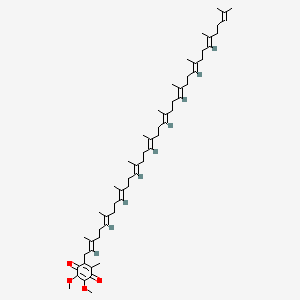
- Formula
- C59H90O4
- Weight
- 863.3 Da
- PubChem CID
- 5281915
- Exact Mass
- 862.6839 Da
- LogP
- 19.4
- TPSA
- 52.6 Ų
- H-Bond Donors
- 0
- H-Bond Acceptors
- 4
- Rotatable Bonds
- 31
- Complexity
- 1840
Identifiers (SMILES, InChI)
InChI=1S/C59H90O4/c1-44(2)24-15-25-45(3)26-16-27-46(4)28-17-29-47(5)30-18-31-48(6)32-19-33-49(7)34-20-35-50(8)36-21-37-51(9)38-22-39-52(10)40-23-41-53(11)42-43-55-54(12)56(60)58(62-13)59(63-14)57(55)61/h24,26,28,30,32,34,36,38,40,42H,15-23,25,27,29,31,33,35,37,39,41,43H2,1-14H3/b45-26+,46-28+,47-30+,48-32+,49-34+,50-36+,51-38+,52-40+,53-42+
ACTIUHUUMQJHFO-UPTCCGCDSA-NReferences (9)
- [1]Coenzyme Q10 supplementation: Efficacy, safety, and formulation challenges
→ Comprehensive review establishing CoQ10 as the third most consumed dietary supplement with potential therapeutic applications in cardiovascular and neurodegenerative diseases, noting excellent safety record and absorption challenges due to hydrophobicity.
- [6]Coenzyme Q10 supplementation for prophylaxis in adult patients with migraine-a meta-analysis
→ Meta-analysis demonstrating CoQ10's effectiveness in reducing severity, frequency, and duration of migraine attacks in adult patients when used as prophylactic treatment.
- [2]Effects of Coenzyme Q10 on Statin-Induced Myopathy: An Updated Meta-Analysis of Randomized Controlled Trials
→ Meta-analysis of 12 randomized controlled trials investigating whether CoQ10 supplementation ameliorates statin-induced myopathy and muscle symptoms, addressing the association between statin treatment and CoQ10 depletion.
- [3]The Effect of CoQ10 supplementation on ART treatment and oocyte quality in older women
→ CoQ10 supplementation improved fertilization rates, embryo quality, and reduced chromosomal abnormalities in women aged 31+ undergoing IVF/IVM treatment, with proposed mechanisms including restoration of mitochondrial function and reduction of oxidative stress.
- [7]Improvement of migraine symptoms with a proprietary supplement containing riboflavin, magnesium and Q10
→ Randomized, double-blind, multicenter trial showing significant reduction in migraine days (from 6.2 to reduced levels) with a combination supplement containing CoQ10, magnesium, and riboflavin over 3 months.
- [8]Efficacy and Optimal Dose of Coenzyme Q10 Supplementation on Inflammation-Related Biomarkers
→ GRADE-assessed systematic review and meta-analysis of 67 randomized controlled trials evaluating CoQ10's effects on inflammatory biomarkers and determining optimal dosing for anti-inflammatory benefits.
- [9]Coenzyme Q10: absorption, tissue uptake, metabolism and pharmacokinetics
→ Review establishing that CoQ10 has slow and limited absorption due to hydrophobicity, peak plasma levels at 6 hours, elimination half-life of 33 hours, and that solubilized formulations show enhanced bioavailability with uptake in all tissues including heart and brain mitochondria.
- [4]Antioxidants and Fertility in Women with Ovarian Aging: A Systematic Review and Meta-Analysis
→ Meta-analysis evaluating various antioxidants including CoQ10 for fertility outcomes in women with ovarian aging, addressing the role of oxidative stress in age-related fertility decline.
- [5]Mitochondrial Dysfunction and Coenzyme Q10 Supplementation in Post-Viral Fatigue Syndrome: An Overview
→ Review examining CoQ10's role in treating post-viral fatigue syndromes including ME/CFS, fibromyalgia, and long COVID, focusing on mitochondrial dysfunction as a key pathological mechanism in these conditions.
Continue researching CoQ10 (Coenzyme Q10)
Keep scientific evidence separate from commercial availability. Review how claims are evaluated, explore question-led research paths, or inspect disclosed source records without changing the editorial conclusions on this page.