Chonluten
Chonluten is a short tripeptide bioregulator (Glu-Asp-Gly) that modulates gene expression related to inflammation and antioxidant activity, with primary research focus on lung tissue and secondary effects in the gastrointestinal tract.
Evidence-led profile
Research snapshot
- Evidence stage
- moderate-research
- References
- 11 linked sources
- Research coverage
- 4 areas
- Editorial review
- Mar 8, 2026
Published by the PepGuide Editorial Team using our research methodology.
Overview
Chonluten, also called tripeptide T-34, belongs to a class of short peptide bioregulators developed at the St. Petersburg Institute of Bioregulation and Gerontology. Di-, tri-, and tetrapeptides in this class have been shown to increase lifespan by as much as 40% in animal studies, suppressing the development of both spontaneous and induced tumors while slowing age-related biomarker decline (Anisimov & Khavinson, 2010).
Research demonstrates that short peptides can regulate all aspects of gene expression, including epigenetic DNA methylation (Khavinson et al., 2021). Modeling studies show that a single short peptide can regulate dozens of genes by penetrating both cytoplasmic and nuclear membranes to bind directly to DNA at promoter, suppressor, and other control regions (Fedoreyeva et al., 2011).
Research
Lung Tissue Effects
Chonluten displays tissue-specific activity in the lungs, altering DNA expression in a way that normalizes bronchial mucosa. The bronchial epithelium serves as the barrier between inhaled air and the cardiovascular system, and it can be disrupted by inflammatory conditions such as asthma and COPD, leading to changes in mucus production and extracellular matrix structure. By modulating the expression of anti-inflammatory and antioxidant genes, Chonluten helps restore normal mucosal function in the setting of chronic lung disease (Khavinson et al., 2012).
Gastrointestinal Effects
The effects of Chonluten in the GI tract parallel its pulmonary activity, though at a reduced magnitude. Research suggests it may be useful in reducing inflammation and vascular changes in the GI tract resulting from inflammatory diseases such as Crohn's disease and ulcerative colitis. Investigation of this aspect remains ongoing (Khavinson et al., 2012).
Geroprotective Properties
Studies on bioregulatory peptides demonstrate that Chonluten and related short peptides can suppress spontaneous and induced tumor development while slowing age-related decline in physiological biomarkers. This combination of anti-tumor and anti-aging effects has led researchers to classify Chonluten as a geroprotective agent (Anisimov & Khavinson, 2010). Research in skin cell cultures from both young and old rats showed that bioregulatory tripeptides including Chonluten stimulate cell proliferation and tissue repair, with effects that are more pronounced in older tissue (Voicekhovskaya et al., 2012).
COVID-19 Potential
Chonluten and its related peptide Bronchogen have been evaluated for their potential in treating bronchopulmonary pathology. Chonluten appears to improve the effectiveness of standard therapy in chronic bronchitis with an asthmatic component, exhibits stress-protective effects, and improves physical performance and organism function under hypoxic conditions. These properties make it a candidate adjuvant in multi-component therapeutic approaches for respiratory viral infections (Khavinson et al., 2020).
Safety and Limitations
Chonluten has been studied primarily in animal models and cell cultures. In the available literature, no significant adverse effects have been reported. As a naturally occurring tripeptide sequence, it is expected to have low immunogenicity and toxicity. However, formal clinical safety trials in humans are limited, and a comprehensive safety profile has not been established.
Common Side Effects
- Generally well-tolerated
- Minimal side effects reported
Contraindications
- Active respiratory emergencies (seek medical care)
- Known hypersensitivity
- Pregnancy or breastfeeding
Discontinue If
- Allergic reactions
- Unusual respiratory symptoms
Mechanism of Action
Chonluten exerts its effects through direct binding to DNA, modulating the expression of several key genes involved in inflammation and oxidative stress. Its effects appear to be mediated through regulation of:
- c-Fos -- a potent general regulator of cell proliferation, differentiation, and survival that is activated in response to cellular damage and hypoxia. Widespread c-Fos expression can lead to thickened bronchial mucosa and contribute to cancer development.
- HSP70 -- heat shock protein gene involved in cellular stress responses.
- SOD -- superoxide dismutase, a critical antioxidant enzyme.
- COX-2 -- cyclooxygenase-2, a key mediator of inflammatory signaling.
- TNF-alpha -- tumor necrosis factor alpha, a pro-inflammatory cytokine.
By regulating c-Fos activity in particular, Chonluten may address one of the underlying pathophysiological changes seen in asthma and COPD, where aberrant c-Fos expression drives bronchial mucosal thickening (Khavinson et al., 2012).
Short peptides like Chonluten can regulate gene expression by penetrating cell and nuclear membranes to bind directly to DNA via docking at promoter and suppressor regions (Khavinson et al., 2016).
Research protocol summary
- Typical Dose
- 10-20 mg daily
- Frequency
- Once daily for 10-20 consecutive days
- Route
- Oral, Subcutaneous
- Cycle Length
- 10-20 days per cycle
- Storage
- Capsules: room temperature; Injectable lyophilized: 2-8°C; Reconstituted: 2-8°C refrigerated
These values summarize cataloged research protocols. They are not personal dosing instructions or medical guidance.
Reconstitution Calculator
Pharmacokinetic Profile
- Half-life
- Minutes (short peptide); effects persist via epigenetic changes
Molecular Structure
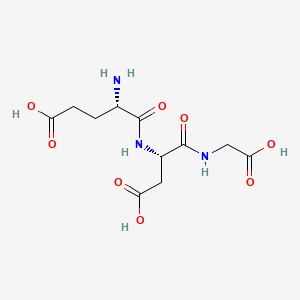
- Formula
- C11H17N3O8
- Weight
- 319 Da
- Length
- 3 amino acids
- CAS
- 75007-24-8
- PubChem CID
- 194641
- Exact Mass
- 319.1016 Da
- LogP
- -5.3
- TPSA
- 196 Ų
- H-Bond Donors
- 6
- H-Bond Acceptors
- 9
- Rotatable Bonds
- 10
- Complexity
- 464
Identifiers (SMILES, InChI)
InChI=1S/C11H17N3O8/c12-5(1-2-7(15)16)10(21)14-6(3-8(17)18)11(22)13-4-9(19)20/h5-6H,1-4,12H2,(H,13,22)(H,14,21)(H,15,16)(H,17,18)(H,19,20)/t5-,6-/m0/s1
DSPQRJXOIXHOHK-WDSKDSINSA-NResearch Indications
Respiratory Support
Normalizes respiratory system function through gene expression regulation.
Restores and maintains lung alveolar tissues and bronchial mucous membranes.
May modulate mucosal function in chronic obstructive pulmonary disease.
Anti-Inflammatory
Inhibits TNF production in monocytes, reducing inflammatory responses.
Supports SOD and antioxidant gene expression.
Anti-Aging
Researched as potential agent that may slow cell aging.
Modulates c-Fos and proliferative gene activity.
Research Protocols
sublingual Injection
Sublingual (lingual) form available for enhanced absorption.
| Goal | Dose | Frequency | Duration |
|---|---|---|---|
| Enhanced absorption | 10-20 mg | Daily for 10-20 days | —(Route: Sublingual) |
oral
Available in capsule form for oral administration. As a tripeptide, Chonluten has favorable permeability across cellular compartments. Typical protocol involves 10-20 day cycles.
| Goal | Dose | Frequency | Duration |
|---|---|---|---|
| Standard protocol | 10-20 mg | Daily for 10-20 days | —(Route: Oral capsules) |
subcutaneous Injection
Respiratory bioregulator peptide. Aggressive titration from 250 mcg to 4 mg over 16 weeks.
| Goal | Dose | Frequency | Duration |
|---|---|---|---|
| Week 1-2 | 250 mcg | Once daily | Weeks 1-2 |
| Week 3-4 | 500 mcg | Once daily | Weeks 3-4 |
| Week 5-6 | 1,000 mcg | Once daily | Weeks 5-6 |
| Week 7-8 | 1,500 mcg | Once daily | Weeks 7-8 |
| Week 9-10 | 2,000 mcg | Once daily | Weeks 9-10 |
| Week 11-12 | 3,000 mcg | Once daily | Weeks 11-12 |
| Full dose | 4,000 mcg | Once daily | Weeks 13-16(Cycle 8-16 weeks) |
Reconstitution Guide (20mg vial + 3mL BAC water)
- Wipe vial tops with alcohol swab
- Draw 3.0 mL bacteriostatic water into syringe
- Inject slowly down the inside wall of the peptide vial
- Gently swirl to dissolve — never shake
- Resulting concentration: 6.67 mg/mL
- For 250 mcg dose: draw 3.75 units (0.0375 mL)
- For 1,000 mcg (1 mg) dose: draw 15 units (0.15 mL)
- For 2,000 mcg (2 mg) dose: draw 30 units (0.30 mL)
- For 4,000 mcg (4 mg) dose: draw 60 units (0.60 mL)
- Store reconstituted vial refrigerated at 2-8°C
Interactions
Peptide Interactions
Related respiratory bioregulators; complementary mechanisms.
Often combined in comprehensive anti-aging Khavinson protocols.
Both have immune-modulating properties; different tissue targets.
Both support mucosal health through different mechanisms.
Reported Research Timeline
Gene expression modulation and anti-inflammatory effects begin
Effects persist due to epigenetic changes
Respiratory function improvements
Cumulative benefits with periodic cycles
Quality Indicators
What to look for
- White powder or capsules
- Clear solution if reconstituted
- Proper packaging and labeling
Caution
- Unknown source or purity
Red flags
- Discoloration
- Unusual odor
- Damaged packaging
Frequently Asked Questions
References (11)
- [2]Chonluten and Gene Expression Regulation (2018)
- [3]Bronchial Bioregulator Peptides (2016)
- [4]Khavinson Peptide Bioregulators (2020)
- [11]
- [1]
- [5]Khavinson VK et al Peptidergic regulation of expression of genes encoding antioxidant and anti-inflammatory proteins Bull Exp Biol Med (2012)
- [6]Anisimov VN, Khavinson VK Peptide bioregulation of aging: results and prospects Biogerontology (2010)
- [7]Voicekhovskaya MA et al Effect of bioregulatory tripeptides on the culture of skin cells from young and old rats Bull Exp Biol Med (2012)
- [9]
- [10]Fedoreyeva LI et al Penetration of short fluorescence-labeled peptides into the nucleus in HeLa cells and in vitro specific interaction of the peptides with deoxyribooligonucleotides and DNA Biochemistry (Moscow) (2011)
- [8]
Continue researching Chonluten
Keep scientific evidence separate from commercial availability. Review how claims are evaluated, explore question-led research paths, or inspect disclosed source records without changing the editorial conclusions on this page.