CJC-1295 with DAC
CJC-1295 DAC is a synthetic growth hormone-releasing hormone (GHRH) analogue consisting of the first 29 amino acids of GHRH, conjugated with a drug affinity complex (DAC) that extends its plasma half-life to approximately 6-8 days.
Evidence-led profile
Research snapshot
- Evidence stage
- Established research record
- References
- 8 linked sources
- Research coverage
- 5 areas
- Editorial review
- Mar 8, 2026
Published by the PepGuide Editorial Team using our research methodology.
Overview
Growth hormone-releasing hormone (GHRH) has been modified to produce analogues that preserve certain physiologic effects while improving pharmacokinetic properties. CJC-1295 consists of the first 29 amino acids of GHRH (a maleimido derivative of hGRF(1-29)) and was developed to create a more soluble GH secretagogue that is easier to manufacture in quantity while preserving the physiologic actions of native GHRH.
CJC-1295 was originally developed by ConjuChem Biotechnologies with the DAC moiety included, and the combination was simply called "CJC-1295." When the peptide began to be offered without DAC, naming confusion arose. The convention now is: CJC-1295 DAC refers to the molecule with the drug affinity complex, while CJC-1295 (or CJC-1295 no-DAC) refers to the peptide without it.
Research
Growth Hormone Release
A single dose of CJC-1295 increases GH levels by 2-10 fold in animal models. Peak GH levels are reached approximately 2 hours after administration and effects persist for about six days. Critically, CJC-1295 preserves the normal pulsatile pattern of GH release, meaning circadian peaks and valleys remain intact. This physiologic secretion pattern avoids the side effects associated with continuous GH elevation and preserves downstream effects on hyperplasia, hypertrophy, bone density, blood sugar, fat metabolism, protein synthesis, and myocardial function (Ionescu & Frohman, 2006).
Growth Normalization
Studies in GHRH knockout mice demonstrated that once-daily administration of CJC-1295 normalizes GH release and growth patterns. This finding makes CJC-1295 potentially useful as a therapy for growth abnormalities in various mammalian species. Preserving normal pulsatile GH release is critical for appropriate downstream signaling, particularly through IGF-1 (Alba et al., 2006).
Fertility
Research from the early 1990s suggests that CJC-1295 and other GRF analogues may promote ovulation in infertile patients. Ovulation is dependent on IGF-1 and is influenced by GH release cycling. Animal models of superovulation have confirmed that both GH and IGF-1 levels rise significantly around the time of ovulation, and exogenous administration of GH secretagogues is sufficient to induce appropriate ovulation (Volpe et al., 1991). There is speculation that CJC-1295 may also be useful in male infertility through regulation of spermatogenesis, though this remains untested.
Ongoing & Future Research
CJC-1295 DAC is not currently in active clinical development following the discontinuation of ConjuChem's program. However, the broader GHRH analog class remains an active area of research:
- NCT00071240 -- Phase 2 study of CJC-1295 (ConjuChem) evaluating pharmacokinetics and GH/IGF-1 response in healthy adults. Completed; provided the foundational PK data.
- NCT00935493 -- Tesamorelin (GHRH analog) Phase 3 study in HIV lipodystrophy, demonstrating the clinical viability of the GHRH analog class.
- NCT02696642 -- Study of tesamorelin effects on liver fat in HIV, extending GHRH analog applications to hepatic steatosis.
- NCT03375112 -- Tesamorelin for peripheral neuropathy in prediabetes and diabetes, exploring neurotrophic effects of GHRH-pathway stimulation.
- NCT01263041 -- MK-677 (oral GH secretagogue) in Alzheimer's disease, investigating GH/IGF-1 axis modulation in neurodegeneration.
Research outlook: While CJC-1295 DAC itself is unlikely to re-enter formal clinical development, it remains the benchmark long-acting GHRH analog in research. The success of tesamorelin has validated the GHRH analog therapeutic class, and next-generation long-acting GHRH analogs may build on the DAC bioconjugation concept.
Comparison to Related Compounds
| Compound | Half-life | GH Pattern | Mechanism | FDA Status |
|---|---|---|---|---|
| CJC-1295 DAC | ~6-8 days | Sustained elevation with preserved pulsatility | GHRH-R agonist + albumin conjugation | Not approved |
| Mod GRF 1-29 (CJC-1295 no DAC) | ~30 minutes | Discrete pulsatile | GHRH-R agonist | Not approved |
| Sermorelin | ~10-12 minutes | Pulsatile (brief) | GHRH-R agonist (native GRF 1-29) | FDA-approved (discontinued) |
| Tesamorelin (Egrifta) | ~26-38 minutes | Pulsatile | GHRH-R agonist (trans-3-hexenoic acid modified) | FDA-approved (HIV lipodystrophy) |
| MK-677 (ibutamoren) | ~24 hours | Sustained elevation | GHS-R1a agonist (oral, non-peptide) | Not approved |
| Ipamorelin | ~2 hours | Pulsatile | GHS-R1a agonist (selective GHRP) | Not approved |
Key distinctions:
- CJC-1295 DAC vs Mod GRF 1-29: The DAC moiety extends half-life from ~30 minutes to ~6-8 days through covalent albumin binding. This enables weekly rather than multiple-daily dosing but produces sustained rather than discrete GH pulses. Mod GRF 1-29 more closely mimics physiological GHRH pulsatility, while CJC-1295 DAC provides continuous GH axis stimulation with greater convenience.
- CJC-1295 DAC vs sermorelin: Sermorelin is unmodified GHRH (1-29) with a half-life under 12 minutes, requiring multiple daily injections for meaningful GH elevation. CJC-1295 DAC achieves equivalent or greater GH stimulation with weekly dosing. Sermorelin was FDA-approved but commercially discontinued due to supply issues, not safety concerns.
- CJC-1295 DAC vs tesamorelin: Tesamorelin is the only GHRH analog currently FDA-approved (for HIV-associated lipodystrophy). It has a slightly longer half-life than sermorelin (~26-38 min) but still requires daily dosing. Tesamorelin has demonstrated reduction in visceral adipose tissue and hepatic fat (Stanley et al., 2015).
- CJC-1295 DAC vs MK-677: MK-677 is an oral, non-peptide ghrelin receptor agonist with a ~24-hour half-life. It acts through the GHRP/ghrelin pathway rather than the GHRH pathway, making it mechanistically complementary to CJC-1295 DAC. MK-677 is more convenient (oral dosing) but may increase appetite and cortisol through ghrelin-mediated effects.
Safety and Limitations
In clinical studies, CJC-1295 DAC has been generally well tolerated. Reported side effects include injection site reactions (redness, swelling), transient flushing, and headache. Because it preserves physiologic pulsatile GH release rather than producing supraphysiologic continuous elevation, the side effect profile is considered more favorable than that of exogenous GH. However, long-term safety data in humans remains limited. As with all GH secretagogues, potential concerns include effects on glucose metabolism and theoretical risks related to sustained IGF-1 elevation.
Common Side Effects
- Water retention
- Joint pain
- Carpal tunnel symptoms
Contraindications
- Diabetes history
- Cancer history
- Predisposed sleep apnea
Discontinue If
- Severe joint pain or carpal tunnel syndrome
- Excessive water retention affecting daily life
- Numbness or tingling in extremities
- Significant blood glucose dysregulation
- Signs of acromegaly (jaw growth, hand/feet enlargement)
- Persistent lethargy indicating adrenal effects
Mechanism of Action
CJC-1295 acts on the GHRH receptor (GHRH-R) on anterior pituitary somatotroph cells, stimulating the synthesis and pulsatile release of growth hormone. The DAC component binds to albumin via a reactive chemical group, forming a stable bioconjugate that circulates for days rather than minutes.
Key mechanistic features:
- Preserved pulsatility -- Unlike exogenous GH administration, CJC-1295 DAC maintains the normal circadian peaks and valleys of endogenous GH secretion (Ionescu & Frohman, 2006).
- Extended half-life -- The DAC-albumin conjugation extends half-life from minutes (native GRF) to approximately 6-8 days.
- IGF-1 elevation -- Downstream IGF-1 levels increase proportionally to GH output, mediating many of the anabolic effects.
Research protocol summary
- Typical Dose
- 1-2mg weekly
- Frequency
- Once or twice weekly (e.g., Monday/Thursday for split dosing)
- Route
- Subcutaneous injection
- Cycle Length
- 8-12 weeks
- Storage
- Lyophilized: 2-8°C refrigerated; Reconstituted: 2-8°C refrigerated, use within 30 days
These values summarize cataloged research protocols. They are not personal dosing instructions or medical guidance.
Reconstitution Calculator
Pharmacokinetic Profile
CJC-1295 with DAC — Pharmacokinetic Curve
Subcutaneous injectionIllustrative model from the listed half-life and time to peak, not measured concentration data.
Molecular Structure
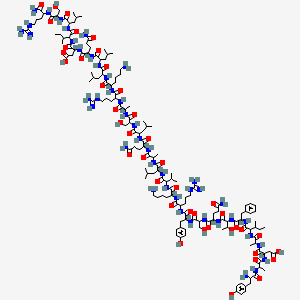
- Formula
- C152H252N44O42
- Weight
- 3 Da
- Length
- 30 amino acids
- CAS
- 863288-34-0
- PubChem CID
- 91976842
- Exact Mass
- 3366.8969 Da
- LogP
- -10.7
- TPSA
- 1450 Ų
- H-Bond Donors
- 52
- H-Bond Acceptors
- 48
- Rotatable Bonds
- 118
- Complexity
- 7710
Identifiers (SMILES, InChI)
InChI=1S/C152H252N44O42/c1-22-79(15)118(194-125(214)84(20)171-135(224)107(68-115(206)207)181-124(213)81(17)169-126(215)91(155)65-87-41-45-89(201)46-42-87)147(236)189-106(66-86-34-25-24-26-35-86)141(230)196-120(85(21)200)149(238)180-99(51-54-114(158)205)132(221)190-111(72-199)145(234)185-105(67-88-43-47-90(202)48-44-88)140(229)178-96(40-33-59-168-152(164)165)128(217)177-94(37-28-30-56-154)133(222)193-117(78(13)14)146(235)187-100(60-73(3)4)134(223)170-82(18)123(212)175-97(49-52-112(156)203)130(219)183-103(63-76(9)10)138(227)191-109(70-197)143(232)172-83(19)122(211)174-95(39-32-58-167-151(162)163)127(216)176-93(36-27-29-55-153)129(218)182-102(62-75(7)8)137(226)184-101(61-74(5)6)136(225)179-98(50-53-113(157)204)131(220)186-108(69-116(208)209)142(231)195-119(80(16)23-2)148(237)188-104(64-77(11)12)139(228)192-110(71-198)144(233)173-92(121(159)210)38-31-57-166-150(160)161/h24-26,34-35,41-48,73-85,91-111,117-120,197-202H,22-23,27-33,36-40,49-72,153-155H2,1-21H3,(H2,156,203)(H2,157,204)(H2,158,205)(H2,159,210)(H,169,215)(H,170,223)(H,171,224)(H,172,232)(H,173,233)(H,174,211)(H,175,212)(H,176,216)(H,177,217)(H,178,229)(H,179,225)(H,180,238)(H,181,213)(H,182,218)(H,183,219)(H,184,226)(H,185,234)(H,186,220)(H,187,235)(H,188,237)(H,189,236)(H,190,221)(H,191,227)(H,192,228)(H,193,222)(H,194,214)(H,195,231)(H,196,230)(H,206,207)(H,208,209)(H4,160,161,166)(H4,162,163,167)(H4,164,165,168)
XOZMWINMZMMOBR-UHFFFAOYSA-NResearch Indications
Growth Hormone
Continuous growth hormone release for 6-8 days per injection.
Significantly elevates IGF-1 levels for extended periods.
Weekly dosing ideal for simple administration.
Body Composition
Continuous GH elevation promotes lipolysis and fat metabolism.
Sustained anabolic environment supports muscle protein synthesis.
Anti-Aging
Accelerated healing and recovery from exercise or injury.
Research Protocols
subcutaneous Injection
Long-acting GHRH analog with Drug Affinity Complex. Administered once weekly at bedtime on an empty stomach.
| Goal | Dose | Frequency | Duration |
|---|---|---|---|
| Conservative | 1,000 mcg (1 mg) | Once weekly | 8-12 weeks(Optional 4-week break between cycles) |
| Standard | 2,000 mcg (2 mg) | Once weekly | 8-12 weeks(Optional 4-week break between cycles) |
Reconstitution Guide (2mg vial + 1mL BAC water)
- Wipe vial tops with alcohol swab
- Draw 1.0 mL bacteriostatic water into syringe
- Inject slowly down the inside wall of the peptide vial
- Gently swirl to dissolve — never shake
- Resulting concentration: 2.0 mg/mL
- For 1,000 mcg (1 mg) dose: draw 50 units (0.50 mL)
- For 2,000 mcg (2 mg) dose: draw 100 units (1.00 mL)
- Store reconstituted vial refrigerated at 2-8°C
Interactions
Peptide Interactions
- CJC-1295 DAC vs MK-677: MK-677 is an oral, non-peptide ghrelin receptor agonist with a ~24-hour half-life.
Reported Research Timeline
Possible water retention, improved sleep, increased appetite
Noticeable recovery improvements, some report joint discomfort
Visible body composition changes, increased vascularity
Continued improvements but watch for desensitization signs
Most gains maintained; IGF-1 returns to baseline in 2-3 weeks
Quality Indicators
What to look for
- High purity requirement (>98%); impurities cause more side effects
- Proper DAC labeling; legitimate products clearly state 'with DAC'
Caution
- Higher cost than non-DAC (2-3x more due to complex manufacturing)
- Foaming during mixing is normal for DAC peptides; wait for foam to settle
Red flags
- Extremely cheap pricing (if priced similar to non-DAC, likely mislabeled)
- Clear solution immediately (should be slightly cloudy initially)
Frequently Asked Questions
References (8)
- [1]Prolonged Growth Hormone Elevation with CJC-1295 DAC (2006)
- [2]Dose-Response Relationship of CJC-1295 DAC (2008)
- [3]Long-term Effects on GH/IGF-1 Axis (2012)
- [4]Comparative Pharmacokinetics: DAC vs Non-DAC Variants (2015)
- [5]Ionescu M, Frohman LA Pulsatile secretion of growth hormone (GH) persists during continuous stimulation by CJC-1295, a long-acting GH-releasing hormone analog J Clin Endocrinol Metab (2006)
- [6]Alba M et al Once-daily administration of CJC-1295, a long-acting growth hormone-releasing hormone (GHRH) analog, normalizes growth in the GHRH knockout mouse Am J Physiol Endocrinol Metab (2006)
- [7]Volpe A et al Clinical use of growth hormone-releasing factor for induction of superovulation Hum Reprod (1991)
- [8]Teichman SL et al Prolonged stimulation of growth hormone (GH) and insulin-like growth factor I secretion by CJC-1295, a long-acting analog of GH-releasing hormone, in healthy adults J Clin Endocrinol Metab (2006)
Continue researching CJC-1295 with DAC
Keep scientific evidence separate from commercial availability. Review how claims are evaluated, explore question-led research paths, or inspect disclosed source records without changing the editorial conclusions on this page.