Alpha-Defensins (HNP-1 to HNP-4, HD-5, HD-6)
Alpha-defensins are 29-35 amino acid cysteine-rich antimicrobial peptides stored in neutrophil azurophilic granules (HNP-1 to HNP-4) and Paneth cells (HD-5, HD-6), forming the first line of innate immune defense through membrane pore formation and immunomodulation.
Evidence-led profile
Research snapshot
- Evidence stage
- Emerging research
- References
- 20 linked sources
- Research coverage
- 7 areas
- Editorial review
- Jul 7, 2026
Published by the PepGuide Editorial Team using our research methodology.
Overview
Alpha-defensins were first isolated from human neutrophils by Selsted, Harwig, and Lehrer in 1980-1985, establishing them as a major class of antimicrobial peptides in mammalian innate immunity. HNP-1, HNP-2, and HNP-3 differ by only a single N-terminal amino acid (alanine, no residue, and aspartate, respectively), while HNP-4 is the most divergent and most potent antibacterial of the neutrophil defensins. Together, HNP-1 to HNP-3 comprise approximately 30-50% of the total protein content of azurophilic granules, reaching concentrations exceeding 10 mg/mL within the phagolysosome upon degranulation.
The enteric defensins HD-5 and HD-6 are produced exclusively by Paneth cells and secreted into the intestinal crypt lumen, where they regulate the composition of the intestinal microbiome and defend against enteric pathogens. HD-5 is synthesized as a 94-amino acid propeptide and processed by trypsin to the mature 32-residue form. HD-6 is unique among defensins in that its primary antimicrobial mechanism involves formation of self-assembling nanonets that physically entrap bacteria rather than killing them through membrane disruption Chu et al. (2012).
Research
Defensin Structure and the Beta-Sheet Fold
The three-dimensional structures of alpha-defensins reveal a highly conserved fold: a triple-stranded antiparallel beta-sheet stabilized by three disulfide bonds. This rigid framework creates an amphipathic molecule with a cationic surface for membrane binding and a hydrophobic core for structural stability. Hill et al. solved the crystal structure of HNP-3, revealing that defensins form dimers that further assemble into higher-order oligomers — a process critical for membrane pore formation. The dimeric basket-like structure creates a polar channel that can span the lipid bilayer Hill et al. (1991).
Neutrophil Defensins and Antimicrobial Defense
The neutrophil defensins HNP-1 to HNP-4 are among the most abundant antimicrobial effectors in human innate immunity. Upon neutrophil activation and degranulation, defensins are released into the phagolysosome at concentrations sufficient to kill ingested bacteria within minutes. Lehrer et al. established that HNP-1 to HNP-3 exhibit broad-spectrum bactericidal activity against gram-positive and gram-negative bacteria, fungi, and enveloped viruses at micromolar concentrations. HNP-4 is the most potent antibacterial defensin but is present at lower concentrations (~1% of neutrophil defensins) Wilde et al. (1989).
Enteric Defensins and Intestinal Homeostasis (HD-5/HD-6)
HD-5 and HD-6 are critical regulators of intestinal microbial ecology. Paneth cells at the crypt base secrete defensins into the intestinal lumen in response to bacterial products (muramyl dipeptide, LPS) and cholinergic stimulation. Transgenic mice expressing human HD-5 in Paneth cells are protected against oral challenge with Salmonella typhimurium, demonstrating the in vivo antimicrobial importance of enteric defensins Salzman et al. (2003). Conversely, Paneth cell defensin deficiency, as seen in ileal Crohn's disease, is associated with altered microbiome composition and increased susceptibility to bacterial invasion Wehkamp et al. (2005).
Cancer Biomarker Potential
Elevated plasma and tissue levels of alpha-defensins have been reported in multiple cancers, with particular interest in colorectal cancer. Albrethsen et al. (2005) identified HNP-1 to HNP-3 as significantly elevated in the serum of colorectal cancer patients compared to healthy controls using SELDI-TOF mass spectrometry. The defensin elevation likely reflects tumor-associated neutrophil infiltration and inflammation rather than tumor-derived expression. While alpha-defensin levels alone lack sufficient specificity for standalone diagnostic use, they show promise as components of multi-marker panels for early colorectal cancer detection Albrethsen et al. (2005).
HIV-1 Inhibition by HNP-1
Chang et al. (2005) identified alpha-defensins HNP-1 to HNP-3 as a major component of the CD8+ T cell antiviral factor (CAF) responsible for suppression of HIV-1 replication. HNP-1 inhibits HIV-1 at multiple stages: direct virucidal activity through disruption of the viral envelope, blocking of viral entry by interfering with gp120-CD4 binding, and inhibition of post-entry viral replication steps. Elevated alpha-defensin levels have been associated with slower HIV-1 disease progression in long-term non-progressors Chang et al. (2005). Subsequent work showed that the HIV-inhibitory activity requires the native disulfide-bonded structure and is enhanced by defensin dimerization Demirkhanyan et al. (2012).
Antimicrobial mechanism and spectrum
Alpha-defensins are cationic, tridisulfide-linked beta-sheet peptides that permeabilize microbial membranes and neutralize toxins, providing rapid non-specific innate defense with low resistance development.
- HNP-1 is broadly active against bacteria, fungi, viruses, and Leishmania
- Some pathogens (e.g., A. baumannii via OmpA) exploit HNP1, illustrating a host-pathogen arms race
Translational hurdles
Clinical development of alpha-defensins is limited by cytotoxicity to host cells, salt/serum-dependent activity, and difficulty in large-scale production, keeping them mostly preclinical or as biomarkers.
- Correct disulfide folding is required for bactericidal activity
- Immunomodulatory functions offer therapeutic angles beyond direct killing
Safety and Limitations
Alpha-defensins are endogenous peptides with well-characterized physiological roles, but their safety profile reflects the potency of their biological activities:
- Concentration-dependent cytotoxicity: At high concentrations (>50 μg/mL), HNP-1 to HNP-3 exhibit cytotoxicity toward mammalian epithelial cells and endothelial cells, contributing to tissue damage during excessive neutrophil activation.
- Pro-inflammatory amplification: Elevated defensin levels in chronic inflammatory conditions (rheumatoid arthritis, vasculitis, sepsis) amplify inflammation through chemokine induction, complement activation, and mast cell degranulation.
- Intestinal barrier disruption: Paradoxically, excessive alpha-defensin production or dysregulated processing can disrupt intestinal barrier integrity, potentially exacerbating inflammatory bowel disease.
- Coagulation effects: HNP-1 promotes fibrinolysis inhibition and platelet activation, potentially contributing to thrombotic complications in sepsis and severe inflammation.
- Autoimmune implications: Alpha-defensins have been detected in atherosclerotic plaques and synovial fluid of rheumatoid arthritis patients, suggesting roles in chronic inflammatory and autoimmune pathology.
- Endogenous regulation: Normal defensin levels are tightly regulated through controlled neutrophil degranulation and Paneth cell secretion, with clearance primarily through renal filtration.
Mechanism of Action
Alpha-defensins employ multiple antimicrobial mechanisms depending on the specific isoform:
- Membrane pore formation (HNP-1 to HNP-4): Neutrophil defensins bind to anionic microbial membranes through electrostatic interactions, oligomerize, and form transmembrane pores that cause ion leakage, membrane depolarization, and cell death. The dimeric and higher-order oligomeric structures are essential for pore activity Hill et al. (1991).
- Self-assembling nanonets (HD-6): Unlike other defensins, HD-6 does not directly kill bacteria but instead polymerizes upon contact with bacterial surfaces to form ordered fibrils and nanonets that physically entrap microorganisms, preventing mucosal translocation and systemic invasion Chu et al. (2012).
- Trypsin-dependent activation (HD-5): HD-5 is stored as an inactive propeptide in Paneth cell granules and activated by trypsin cleavage upon secretion into the intestinal crypt lumen. Mature HD-5 kills bacteria through direct membrane disruption and also neutralizes bacterial toxins Ghosh et al. (2002).
- Lectin-like activity: HD-5 binds to specific glycoproteins on microbial surfaces and can block viral entry by cross-linking surface lectins. This mechanism underlies HD-5's inhibition of adenovirus and papillomavirus infections Smith & Bhatt (2011).
- Immunomodulation: HNP-1 to HNP-3 recruit monocytes, T cells, and immature dendritic cells through CCR6-mediated chemotaxis, bridging innate and adaptive immunity. They also enhance phagocytosis, stimulate cytokine production, and modulate complement activation Yang et al. (1999).
Research protocol summary
- Route
- N/A (endogenous); experimental: topical, intravenous (preclinical)
These values summarize cataloged research protocols. They are not personal dosing instructions or medical guidance.
Reconstitution Calculator
Pharmacokinetic Profile
Alpha-Defensins (HNP-1 to HNP-4, HD-5, HD-6) — Pharmacokinetic Curve
N/A (endogenous); experimental: topical, intravenous (preclinical)Illustrative model from the listed half-life and time to peak, not measured concentration data.
Molecular Structure
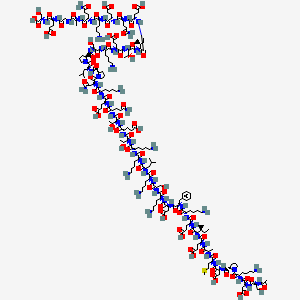
- Formula
- C212H350N56O78S
- Weight
- 4963 Da
- PubChem CID
- 16132341
- Exact Mass
- 4962.4930 Da
- LogP
- -43.5
- TPSA
- 2250 Ų
- H-Bond Donors
- 72
- H-Bond Acceptors
- 88
- Rotatable Bonds
- 180
- Complexity
- 12200
Identifiers (SMILES, InChI)
InChI=1S/C212H350N56O78S/c1-16-106(7)166(261-190(323)131(64-75-160(292)293)231-172(305)109(10)228-174(307)134(78-91-347-15)245-196(329)140(98-165(302)303)255-201(334)147-53-39-88-266(147)209(342)135(52-29-38-87-221)250-197(330)139(97-164(300)301)254-198(331)143(100-269)229-113(14)276)204(337)246-129(62-73-158(288)289)187(320)233-118(47-24-33-82-216)179(312)252-137(94-114-42-19-18-20-43-114)194(327)253-138(96-163(298)299)195(328)237-121(50-27-36-85-219)181(314)258-144(101-270)199(332)239-119(48-25-34-83-217)178(311)251-136(92-104(3)4)193(326)236-116(45-22-31-80-214)175(308)235-122(51-28-37-86-220)189(322)263-168(110(11)273)207(340)249-133(66-77-162(296)297)192(325)264-169(111(12)274)206(339)248-126(58-69-152(224)279)184(317)243-128(61-72-157(286)287)186(319)234-120(49-26-35-84-218)180(313)256-142(95-153(225)280)211(344)268-90-40-54-148(268)202(335)257-141(93-105(5)6)210(343)267-89-41-55-149(267)203(336)259-145(102-271)200(333)238-117(46-23-32-81-215)177(310)244-132(65-76-161(294)295)191(324)265-170(112(13)275)208(341)262-167(107(8)17-2)205(338)247-130(63-74-159(290)291)188(321)241-125(57-68-151(223)278)183(316)242-127(60-71-156(284)285)185(318)232-115(44-21-30-79-213)176(309)240-124(56-67-150(222)277)173(306)227-108(9)171(304)226-99-154(281)230-123(59-70-155(282)283)182(315)260-146(103-272)212(345)346/h18-20,42-43,104-112,115-149,166-170,269-275H,16-17,21-41,44-103,213-221H2,1-15H3,(H2,222,277)(H2,223,278)(H2,224,279)(H2,225,280)(H,226,304)(H,227,306)(H,228,307)(H,229,276)(H,230,281)(H,231,305)(H,232,318)(H,233,320)(H,234,319)(H,235,308)(H,236,326)(H,237,328)(H,238,333)(H,239,332)(H,240,309)(H,241,321)(H,242,316)(H,243,317)(H,244,310)(H,245,329)(H,246,337)(H,247,338)(H,248,339)(H,249,340)(H,250,330)(H,251,311)(H,252,312)(H,253,327)(H,254,331)(H,255,334)(H,256,313)(H,257,335)(H,258,314)(H,259,336)(H,260,315)(H,261,323)(H,262,341)(H,263,322)(H,264,325)(H,265,324)(H,282,283)(H,284,285)(H,286,287)(H,288,289)(H,290,291)(H,292,293)(H,294,295)(H,296,297)(H,298,299)(H,300,301)(H,302,303)(H,345,346)/t106-,107-,108-,109-,110+,111+,112+,115-,116-,117-,118-,119-,120-,121-,122-,123-,124-,125-,126-,127-,128-,129-,130-,131-,132-,133-,134-,135-,136-,137-,138-,139-,140-,141-,142-,143-,144-,145-,146-,147-,148-,149-,166-,167-,168-,169-,170-/m0/s1
UGPMCIBIHRSCBV-XNBOLLIBSA-NResearch Indications
Primary Research Areas
Alpha-defensins (HNP1-4) stored in neutrophil azurophilic granules kill Gram-positive/negative bacteria, fungi, and enveloped viruses by membrane disruption.
HNPs act as chemoattractants and cytokine modulators bridging innate and adaptive immunity.
Alpha-defensins inhibit HIV-1, SARS-CoV-2, and adeno-associated virus in vitro.
Fecal and tissue defensin levels are studied as biomarkers of inflammatory bowel disease, sepsis, and infection.
Research Protocols
topical
Administered via topical.
| Goal | Dose | Frequency | Duration |
|---|---|---|---|
| General Research Protocol | 50 μg | Per protocol | — |
intravenous Injection
Administered via intravenous injection.
| Goal | Dose | Frequency | Duration |
|---|---|---|---|
| Concentration-dependent cytotoxicity | 50 μg | Per protocol | — |
oral
Transgenic mice expressing human HD-5 in Paneth cells are protected against oral challenge with Salmonella typhimurium, demonstrating the in vivo antimicrobial importance of enteric defensins [Salzman et al.
| Goal | Dose | Frequency | Duration |
|---|---|---|---|
| General Research Protocol | 50 μg | Per protocol | — |
Interactions
Peptide Interactions
Alpha-defensins and cathelicidin LL-37 are co-stored in neutrophil granules and exhibit synergistic antimicrobial activity. They disrupt microbial membranes through complementary mechanisms—defensins form pore-like structures while LL-37 operates via carpet-model disruption. Combined MIC values are significantly lower than either alone (Nagaoka et al., 2000; Hancock & Sahl, 2006).
Thymosin alpha-1 enhances innate immune function by promoting dendritic cell maturation and TLR signaling, which upregulates endogenous antimicrobial peptide expression including defensins. The combination provides both direct antimicrobial activity (defensins) and enhanced immune surveillance (thymalfasin) (Romani et al., 2006).
Reported Research Timeline
Effects begin within hours of administration based on half-life of ~2-4 hours (circulating; rapidly cleared renally)
Due to short half-life (~2-4 hours (circulating; rapidly cleared renally)), effects are expected per-dose; consistent daily administration maintains...
Regular administration schedule required; effects are dose-dependent and do not persist between doses
Quality Indicators
What to look for
- Extensive peer-reviewed research base
Frequently Asked Questions
References (20)
- [13]Demirkhanyan LH, Marin M, Padilla-Parra S, et al Multifaceted mechanisms of HIV-1 entry inhibition by human alpha-defensin J Biol Chem (2012)
- [17]Chairatana P, Nolan EM — Human alpha-defensin 6: structure, self-assembly, and enteric defense Acc Chem Res (2024)
- [18]Pero R et al — Antimicrobial peptides as diagnostic and therapeutic biomarkers in cancer Int J Mol Sci (2023)
- [10]Albrethsen J, Bøgebo R, Gammeltoft S, et al Upregulated expression of human neutrophil peptides 1, 2 and 3 (HNP 1-3) in colon cancer serum and tumours BMC Cancer (2005)
- [8]Chu H, Pazgier M, Jung G, et al Human alpha-defensin 6 promotes mucosal innate immunity through self-assembled peptide nanonets Science (2012)
- [12]Deirmengian C, Kardos K, Kilmartin P, et al Diagnosing periprosthetic joint infection: has the era of the biomarker arrived? Clin Orthop Relat Res (2014)
- [1]Selsted ME, Harwig SS, Ganz T, et al Primary structures of three human neutrophil defensins J Clin Invest (1985)
- [2]Hill CP, Yee J, Selsted ME, Eisenberg D Crystal structure of defensin HNP-3, an amphiphilic dimer: mechanisms of membrane permeabilization Science (1991)
- [3]Wilde CG, Griffith JE, Marra MN, et al Purification and characterization of human neutrophil peptide 4, a novel member of the defensin family J Biol Chem (1989)
- [5]Chang TL, Vargas J, DelPortillo A, Klotman ME Dual role of alpha-defensin-1 in anti-HIV-1 innate immunity J Clin Invest (2005)
- [6]Salzman NH, Ghosh D, Huttner KM, et al Protection against enteric salmonellosis in transgenic mice expressing a human intestinal defensin Nature (2003)
- [7]Wehkamp J, Salzman NH, Porter E, et al Reduced Paneth cell alpha-defensins in ileal Crohn's disease Proc Natl Acad Sci USA (2005)
- [4]Yang D, Chertov O, Bykovskaia SN, et al Beta-defensins: linking innate and adaptive immunity through dendritic and T cell CCR6 Science (1999)
- [9]Ghosh D, Porter E, Shen B, et al Paneth cell trypsin is the processing enzyme for human defensin-5 Nat Immunol (2002)
- [16]
- [11]Smith JG, Bhatt A Human alpha-defensin 5 (HD5) prevents adenovirus infection by blocking receptor engagement PLoS Pathog (2011)
- [14]Xu D, Lu W — Alpha-defensins: structure, function, and new insights into antimicrobial mechanism Cell Mol Life Sci (2023)
- [15]Sankaran-Walters S et al — Enteric defensin dysregulation and the gut microbiome in HIV disease progression Mucosal Immunol (2022)
- [19]HNP-1: From Structure to Application Thanks to Multifaceted Functions (2025)
→ Reviews HNP-1 broad-spectrum antibacterial and antiviral activity and the production/mechanism hurdles limiting its clinical translation.
- [20]Human Neutrophil Peptide-1 (HNP-1): A New Anti-Leishmanial Drug Candidate (2013)
→ HNP-1 shows direct antiparasitic activity against Leishmania, extending alpha-defensin utility beyond bacteria.
Continue researching Alpha-Defensins (HNP-1 to HNP-4, HD-5, HD-6)
Keep scientific evidence separate from commercial availability. Review how claims are evaluated, explore question-led research paths, or inspect disclosed source records without changing the editorial conclusions on this page.