Oxytocin
Oxytocin is a 9-amino acid endogenous neuropeptide produced in the hypothalamus that regulates social bonding, stress response, wound healing, and inflammation. It is researched for autism spectrum disorder, anxiety, pain, cardiovascular protection, and anti-inflammatory applications.
Evidence-led profile
Research snapshot
- Evidence stage
- FDA-approved use recorded
- References
- 17 linked sources
- Research coverage
- 7 areas
- Editorial review
- Mar 8, 2026
Published by the PepGuide Editorial Team using our research methodology.
Overview
Oxytocin was the first peptide hormone to be sequenced and synthesized, by Vincent du Vigneaud in 1953, earning him the 1955 Nobel Prize in Chemistry. It is structurally related to vasopressin (antidiuretic hormone), differing by only two amino acids, and the two peptides share partial receptor cross-reactivity.
Oxytocin acts through the oxytocin receptor (OXTR), a G protein-coupled receptor expressed widely in the brain (amygdala, hippocampus, hypothalamus, nucleus accumbens) and periphery (uterus, heart, GI tract, immune cells, skin). This broad distribution underlies oxytocin's remarkably diverse biological effects — from social bonding and anxiety reduction to wound healing and cardioprotection.
Central oxytocin release (within the brain) and peripheral oxytocin release (from the pituitary into blood) can be partially dissociated, complicating therapeutic approaches. Intranasal administration has been the primary route for CNS-targeted research, as it partially bypasses the blood-brain barrier via olfactory and trigeminal nerve pathways.
Research
Autism Spectrum Disorder
Autism research represents the most active clinical application of intranasal oxytocin. Several small trials have shown that single-dose intranasal oxytocin improves eye gaze, facial emotion recognition, and social reciprocity in individuals with ASD (Andari et al., 2010). However, larger randomized trials have produced mixed results. The SOAR trial and other multi-site studies have not consistently replicated early positive findings, suggesting that oxytocin's effects may depend on individual differences in baseline oxytocin levels, OXTR genotype, and social context (Sikich et al., 2021).
Anxiety and Stress Disorders
Oxytocin's anxiolytic effects are well-established in preclinical models and partially confirmed in human studies. Intranasal oxytocin reduces amygdala activation in response to fearful faces (Kirsch et al., 2005), suppresses cortisol responses to psychosocial stress, and reduces anxiety in social phobia. Clinical trials for social anxiety disorder, PTSD, and generalized anxiety have shown promising but inconsistent results, with effect sizes generally modest.
Wound Healing
Oxytocin promotes wound healing through multiple mechanisms. Vitalo et al. (2009) demonstrated that oxytocin accelerates wound healing in socially isolated hamsters, linking social deprivation (and low oxytocin) to impaired healing (Vitalo et al., 2009). Oxytocin stimulates keratinocyte and fibroblast migration, increases angiogenesis at wound sites, and reduces inflammatory cytokine levels. Detillion et al. (2004) showed that oxytocin administration reverses the wound healing impairment caused by social isolation stress (Detillion et al., 2004).
Anti-Inflammatory Effects
Oxytocin exerts significant anti-inflammatory effects across multiple organ systems:
- GI inflammation: Oxytocin reduces intestinal inflammation in colitis models, suppressing TNF-α and NF-κB signaling (Iseri et al., 2005).
- Sepsis: Oxytocin improves survival in sepsis models by reducing systemic inflammation and oxidative stress (Düşünceli et al., 2008).
- Neuroinflammation: Central oxytocin release suppresses microglial activation and neuroinflammatory cascades.
- Cardiovascular inflammation: Oxytocin reduces inflammatory markers in atherosclerosis models.
Cardiovascular Protection
Oxytocin receptors are expressed on cardiomyocytes, and oxytocin has direct cardioprotective effects. Jankowski et al. (2004) demonstrated that oxytocin promotes cardiomyocyte differentiation from stem cells and has natriuretic (sodium-excreting) effects (Jankowski et al., 2004). In ischemia-reperfusion models, oxytocin preconditioning reduces infarct size and improves cardiac function recovery. The peptide also has vasodilatory effects, mediated partly through endothelial NO release.
Pain Modulation
Oxytocin has analgesic properties mediated through both central and peripheral mechanisms. It modulates pain processing in the spinal cord dorsal horn and periaqueductal gray. Intranasal oxytocin reduces pain sensitivity in experimental pain models, with particular efficacy for social pain and headache disorders (Tracy et al., 2015).
Social Bonding and Trust
Oxytocin's role in social bonding has been extensively characterized. Kosfeld et al. (2005) demonstrated in a landmark study that intranasal oxytocin increased trusting behavior in a trust game paradigm (Kosfeld et al., 2005). Subsequent research showed oxytocin enhances emotional recognition, empathy, in-group favoritism, and pair bonding. However, effects are context-dependent — oxytocin can increase out-group hostility and defensive aggression when perceived threats exist (De Dreu et al., 2010).
Safety and Limitations
Synthetic oxytocin (Pitocin) has decades of obstetric safety data. Intranasal oxytocin has been studied in hundreds of clinical trials with a generally favorable safety profile. Common side effects of intranasal administration include mild nasal discomfort and occasional drowsiness. At obstetric IV doses, risks include uterine hyperstimulation, water intoxication (due to antidiuretic effects at high doses), and fetal distress. At the lower intranasal research doses (24 IU), serious adverse effects are rare. Long-term safety data (>6 months) remain limited. Theoretical concerns include OXTR desensitization with chronic use and potential effects on social judgment in vulnerable populations.
Common Side Effects
- Mild headache
- Nasal irritation (intranasal)
- Nausea or vomiting
- Transient blood pressure changes
Contraindications
- Certain obstetric conditions (see prescribing info)
- Pregnancy (without medical supervision)
- Active sinus infection (intranasal)
- Severe hyponatremia
Discontinue If
- Uterine hyperstimulation or fetal distress (injectable)
- Severe or persistent headache
- Signs of water intoxication (confusion, seizures, swelling)
- Severe nasal irritation or bleeding
- Allergic reaction (rash, breathing difficulty)
Mechanism of Action
Oxytocin Receptor Signaling
The oxytocin receptor (OXTR) is a Gq/11-coupled GPCR:
- Gq/PLC/IP3 pathway: Receptor activation stimulates phospholipase C, generating IP3 (calcium release from ER) and DAG (PKC activation). This drives smooth muscle contraction (uterus, myoepithelial cells) and modulates neuronal excitability.
- Gαi coupling: In some cell types, OXTR also couples to Gαi, inhibiting adenylyl cyclase and reducing cAMP — mediating anxiolytic and anti-stress effects.
- Beta-arrestin signaling: OXTR activation recruits beta-arrestins, mediating receptor internalization and activating MAPK/ERK pathways involved in cell growth and differentiation.
Central Nervous System Effects
- Amygdala suppression: Oxytocin reduces amygdala reactivity to threatening stimuli, decreasing fear and anxiety responses (Kirsch et al., 2005).
- Social salience: Enhances attention to social cues (faces, eye contact, vocal prosody) and promotes prosocial behavior.
- Stress axis regulation: Oxytocin suppresses the HPA axis (CRH/ACTH/cortisol), reducing stress reactivity. The OXTR in the paraventricular nucleus directly inhibits CRH neurons (Neumann & Landgraf, 2012).
- Reward circuitry: Oxytocin interacts with dopamine signaling in the nucleus accumbens, contributing to social reward and bonding.
Peripheral Effects
- Uterine contraction: The classical oxytocin effect — smooth muscle contraction in the uterus during labor.
- Milk ejection: Contraction of myoepithelial cells in mammary glands during lactation.
- Anti-inflammatory: Oxytocin suppresses NF-κB signaling and pro-inflammatory cytokines (TNF-α, IL-6) in multiple tissue types.
- Wound healing: Oxytocin promotes keratinocyte migration, fibroblast proliferation, and angiogenesis.
- Cardioprotection: Oxytocin receptors on cardiomyocytes mediate direct protective effects against ischemia-reperfusion injury.
Research protocol summary
- Typical Dose
- Intranasal: 20-24 IU; Injectable: 10-40 IU; Sublingual: 50-100 IU
- Frequency
- As needed for social/sexual support, or 1-2x daily for anxiety/PTSD protocols; max 1 dose per 24hr for sexual function
- Route
- Intravenous, Intramuscular, Intranasal
- Cycle Length
- As needed for research applications; 4-12 weeks for anxiety/autism protocols
- Storage
- Refrigerate at 2-8°C; protect from light
These values summarize cataloged research protocols. They are not personal dosing instructions or medical guidance.
Reconstitution Calculator
Pharmacokinetic Profile
Oxytocin — Pharmacokinetic Curve
Intravenous, Intramuscular, IntranasalIllustrative model from the listed half-life and time to peak, not measured concentration data.
Molecular Structure
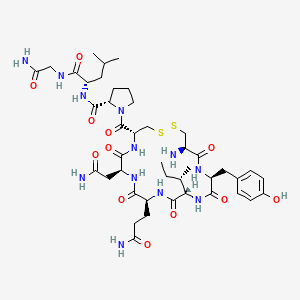
- Formula
- C₄₃H₆₆N₁₂O₁₂S₂
- Weight
- 1 Da
- Length
- 9 amino acids
- CAS
- 50-56-6
- PubChem CID
- 439302
- Exact Mass
- 1006.4365 Da
- LogP
- -2.6
- TPSA
- 450 Ų
- H-Bond Donors
- 12
- H-Bond Acceptors
- 15
- Rotatable Bonds
- 17
- Complexity
- 1870
Identifiers (SMILES, InChI)
InChI=1S/C43H66N12O12S2/c1-5-22(4)35-42(66)49-26(12-13-32(45)57)38(62)51-29(17-33(46)58)39(63)53-30(20-69-68-19-25(44)36(60)50-28(40(64)54-35)16-23-8-10-24(56)11-9-23)43(67)55-14-6-7-31(55)41(65)52-27(15-21(2)3)37(61)48-18-34(47)59/h8-11,21-22,25-31,35,56H,5-7,12-20,44H2,1-4H3,(H2,45,57)(H2,46,58)(H2,47,59)(H,48,61)(H,49,66)(H,50,60)(H,51,62)(H,52,65)(H,53,63)(H,54,64)/t22-,25-,26-,27-,28-,29-,30-,31-,35-/m0/s1
XNOPRXBHLZRZKH-DSZYJQQASA-NResearch Indications
Obstetric (FDA Approved)
Initiates or augments uterine contractions when vaginal delivery medically indicated.
Controls postpartum bleeding through uterine contraction stimulation during third stage.
Adjunctive therapy for incomplete or inevitable abortion in second trimester.
Research/Emerging
Extensive research with mixed results on social functioning; optimal dosing unclear.
Combined with exposure therapy; shows reduced PTSD/depression symptoms.
Decreases amygdala reactivity to social threats; normalizes brain connectivity.
Improves libido, arousal, orgasm intensity in both sexes.
Research Protocols
intranasal Injection
Nasal spray delivers oxytocin directly to brain via olfactory and trigeminal pathways, bypassing blood-brain barrier. Primary research route for psychological/social effects.
| Goal | Dose | Frequency | Duration |
|---|---|---|---|
| Social anxiety/bonding enhancement | 20-24 IU | Once daily or before social situations | —(Route: Intranasal spray) |
| Autism research protocols | 24-48 IU daily | Twice daily | —(Route: Intranasal spray) |
| PTSD therapy augmentation | 40 IU | Before therapy sessions | —(Route: Intranasal spray) |
| Sexual function enhancement | 24-40 IU | 30-45 minutes before activity | —(Route: Intranasal spray) |
Reconstitution Guide (mg vial + mL BAC water)
- If using pre-made compounded spray, proceed to use
- For powder: calculate desired concentration (typically 4-6 IU per 0.1mL)
- Add calculated volume of sterile saline to vial
- Gently swirl until fully dissolved—do not shake
- Transfer to sterile metered-dose nasal spray bottle
- Prime pump with 2-3 sprays before first use
- Store refrigerated 2-8°C; use within 30 days
oral
Sublingual troches provide needle-free administration. Lower bioavailability (~4.5% vs 11% intranasal) requires higher doses.
| Goal | Dose | Frequency | Duration |
|---|---|---|---|
| General wellness/bonding support | 50-100 IU | Once daily | —(Route: Sublingual troche) |
| Sexual function support | 100 IU | 30-45 minutes before activity | —(Route: Sublingual troche) |
subcutaneous Injection
Neuropeptide administered subcutaneously with gradual titration over 12 weeks.
| Goal | Dose | Frequency | Duration |
|---|---|---|---|
| Week 1-2 | 100 mcg | Once daily | Weeks 1-2 |
| Week 3-4 | 200 mcg | Once daily | Weeks 3-4 |
| Week 5-6 | 300 mcg | Once daily | Weeks 5-6 |
| Week 7-8 | 400 mcg | Once daily | Weeks 7-8 |
| Full dose | 500 mcg | Once daily | Weeks 9-12(Cycle 8-12 weeks, extendable to 16) |
Reconstitution Guide (5mg vial + 3mL BAC water)
- Wipe vial tops with alcohol swab
- Draw 3.0 mL bacteriostatic water into syringe
- Inject slowly down the inside wall of the peptide vial
- Gently swirl to dissolve — never shake
- Resulting concentration: 1.67 mg/mL
- For 100 mcg dose: draw 6 units (0.06 mL)
- For 200 mcg dose: draw 12 units (0.12 mL)
- For 300 mcg dose: draw 18 units (0.18 mL)
- For 500 mcg dose: draw 30 units (0.30 mL)
- Store reconstituted vial refrigerated at 2-8°C
Interactions
Peptide Interactions
Complementary anxiolytic effects—Selank modulates GABA; oxytocin acts on central receptors.
Both involved in reproduction; kisspeptin stimulates GnRH; oxytocin enhances arousal.
Closely related neuropeptides with partially overlapping receptor binding. Vasopressin generally promotes vigilance and aggression where oxytocin promotes affiliation. Their balance modulates social behavior.
No direct interactions; different mechanisms (tissue repair vs social function).
No known interactions; different mechanisms—Semax targets cognition, oxytocin targets social/emotional function.
Reported Research Timeline
IV: 1-3 minute onset, 30-60 minute duration; IM: 3-5 minute onset
15-30 minute onset, peak 30-60 minutes, 2-4 hour duration
30-45 minute onset, peak ~60 minutes, 2-4 hour duration
Quality Indicators
What to look for
- FDA-approved pharmaceutical product from licensed pharmacies (injectable)
- Clear, colorless solution without particles or discoloration
- Proper packaging with verified lot number, expiration, concentration
- Licensed compounding pharmacy source with USP compliance
Caution
- Variable compounding quality between pharmacies
- Nasal congestion reduces intranasal absorption
- Sublingual has lower bioavailability than intranasal
Red flags
- Cloudy, discolored, or particulate solution
- From unlicensed or unverified sources
- Improper storage or broken cold chain
Frequently Asked Questions
References (17)
- [3]
- [4]
- [6]
- [1]
- [2]
- [5]
- [7]Kirsch P et al Oxytocin modulates neural circuitry for social cognition and fear in humans J Neurosci (2005)
- [8]Andari E et al Promoting social behavior with oxytocin in high-functioning autism spectrum disorders Proc Natl Acad Sci U S A (2010)
- [9]De Dreu CK et al The neuropeptide oxytocin regulates parochial altruism in intergroup conflict among humans Science (2010)
- [10]Neumann ID, Landgraf R Balance of brain oxytocin and vasopressin: implications for anxiety, depression, and social behaviors Trends Neurosci (2012)
- [11]Sikich L et al Intranasal Oxytocin in Children and Adolescents with Autism Spectrum Disorder N Engl J Med (2021)
- [12]Vitalo A et al Nest making and oxytocin comparably promote wound healing in isolation reared rats PLoS One (2009)
- [13]
- [14]Iseri SO et al Oxytocin ameliorates oxidative colonic inflammation by a neutrophil-dependent mechanism Peptides (2005)
- [15]
- [16]
- [17]Tracy LM et al Oxytocin and the modulation of pain experience: Implications for chronic pain management Neurosci Biobehav Rev (2015)
Continue researching Oxytocin
Keep scientific evidence separate from commercial availability. Review how claims are evaluated, explore question-led research paths, or inspect disclosed source records without changing the editorial conclusions on this page.