Epitalon
Epitalon (Ala-Glu-Asp-Gly) is a synthetic tetrapeptide based on the natural pineal gland peptide epithalamin, developed by Vladimir Khavinson, that activates telomerase and extends telomere length, with demonstrated effects on lifespan extension in animal models and melatonin rhythm restoration.
Evidence-led profile
Research snapshot
- Evidence stage
- Established research record
- References
- 8 linked sources
- Editorial review
- Mar 8, 2026
Published by the PepGuide Editorial Team using our research methodology.
Overview
Epitalon (also spelled epithalon; sequence Ala-Glu-Asp-Gly) is a synthetic tetrapeptide developed by Professor Vladimir Khavinson at the St. Petersburg Institute of Bioregulation and Gerontology as a bioregulatory analogue of epithalamin, a polypeptide extract derived from bovine pineal gland. Epithalamin had been studied since the 1970s in Soviet gerontology for its anti-aging effects, and Epitalon was identified as the minimal active peptide sequence responsible for its principal biological activities, providing a defined, reproducible synthetic alternative.
The most significant mechanism attributed to Epitalon is the activation of telomerase, the reverse transcriptase enzyme that synthesizes telomeric DNA repeats (TTAGGG) at chromosome ends. In a landmark study published in the Bulletin of Experimental Biology and Medicine, Khavinson's group demonstrated that Epitalon induced telomerase activity in human somatic cells (fetal fibroblasts and adult peripheral blood T-cells) and elongated telomeres beyond the critical threshold associated with cellular senescence, enabling cells to exceed the Hayflick limit by additional population doublings. This effect appears to be mediated through transcriptional activation of the hTERT (human telomerase reverse transcriptase) gene, the catalytic subunit of telomerase that is silenced in most adult somatic cells.
Animal longevity studies have shown compelling results: Epitalon treatment increased mean lifespan by 12–13% in multiple rodent strains and by up to 16% in a Drosophila model, while reducing the incidence of spontaneous tumors in aging mice. Additional research has demonstrated that Epitalon restores circadian melatonin production in aged pineal glands by stimulating pinealocyte function, potentially reversing the age-related decline in melatonin secretion that contributes to sleep disruption, immune dysfunction, and oxidative stress in the elderly. Epitalon also upregulates interferon-γ production in aged T-lymphocytes and modulates neuroendocrine function through effects on the hypothalamic-pituitary axis. While animal and in vitro data are extensive, large-scale human clinical trials meeting international regulatory standards have not been conducted, and Epitalon remains an investigational compound primarily available through research chemical suppliers and longevity clinics.
Safety and Limitations
Safety Profile: Epitalon
Common Side Effects
- Injection site reactions: redness, swelling, mild pain, and itching
- Mild fatigue or drowsiness during initial days of treatment
- Headache, usually transient and mild
- Mild gastrointestinal discomfort (nausea)
- Transient flu-like symptoms (malaise, low-grade fever) during first cycle
- Vivid dreams or altered sleep patterns
Serious Adverse Effects
- Allergic reactions including urticaria, angioedema, or anaphylaxis (rare)
- Theoretical risk of promoting growth of existing undetected tumors due to telomerase activation (not confirmed in clinical studies but biologically plausible)
- Immune dysregulation with prolonged unsupervised use
- Rare reports of joint pain or myalgia
- Potential interference with normal cellular senescence mechanisms (long-term consequences unknown)
- No controlled long-term human safety data available
Contraindications
- Known or suspected malignancies (telomerase activation may theoretically promote tumor growth)
- Active autoimmune diseases with flare risk
- Known hypersensitivity to synthetic tetrapeptides
- Pregnancy and breastfeeding (no safety data)
- Children and adolescents under 18 years
- Immunocompromised patients on active immunosuppressive therapy
Drug Interactions
- Immunosuppressants (cyclosporine, tacrolimus): Epitalon's immunomodulatory effects may counteract immunosuppressive therapy
- Chemotherapy agents: Telomerase activation may theoretically reduce efficacy of telomerase-targeted cancer therapies
- Growth hormone and peptide secretagogues: Potential additive effects on cellular proliferation; use with caution
- Melatonin supplements: Epitalon stimulates endogenous melatonin production; combined use may cause excessive sedation
- Corticosteroids: May blunt the immunostimulatory effects of epitalon
Population-Specific Considerations
- Elderly (primary population): Most studied in individuals over 60; generally well tolerated in short courses (10-20 days); monitor for immune changes
- Cancer survivors: Contraindicated until sufficient remission period confirmed by oncologist; theoretical telomerase concerns
- Autoimmune patients: Pineal peptide may modulate T-cell function; risk of flare in autoimmune conditions
- Pregnant/Lactating: No human or adequate animal reproductive data; strictly avoid
- Athletes: Not currently listed on WADA prohibited list but status may change; verify before competition use
- Note: Most published safety data comes from Russian studies with limited sample sizes; independent replication is lacking
Common Side Effects
- Generally well-tolerated with minimal side effects
- Mild injection site reactions
- Vivid dreams (melatonin-related)
- Possible mild digestive upset (oral route)
Contraindications
- Active malignancy (telomerase activation concern)
- Chronic sinusitis (nasal route)
- Known peptide allergies
- Pregnancy or breastfeeding
Discontinue If
- Signs of allergic reaction
- Persistent injection site inflammation
- New or changing moles (monitor skin)
- Cancer diagnosis (discontinue immediately)
- Unusual fatigue or weakness
Mechanism of Action
Telomerase Activation and Telomere Maintenance
Epitalon (epithalon, epithalone) is a synthetic tetrapeptide (Ala-Glu-Asp-Gly) derived from the naturally occurring pineal gland peptide epithalamin. Its primary mechanism involves activation of telomerase reverse transcriptase (hTERT), the catalytic subunit of the telomerase holoenzyme. Epitalon stimulates hTERT gene transcription through derepression of the hTERT promoter, likely via modulation of c-Myc/Max transcription factor binding at E-box elements and displacement of Mad1/Max repressor complexes. Activated telomerase adds TTAGGG hexanucleotide repeats to chromosome 3' overhangs, counteracting the progressive telomere shortening that occurs with each cell division due to the end-replication problem. In human fetal fibroblast cultures, epitalon treatment increased telomerase activity by 2.4-fold and extended replicative lifespan by 10 additional population doublings (PMID: 12937682).
Pineal Gland Restoration and Melatonin Synthesis
Epitalon restores age-related decline in pineal gland function by stimulating melatonin biosynthesis. It upregulates aralkylamine N-acetyltransferase (AANAT) — the rate-limiting enzyme converting serotonin to N-acetylserotonin — and hydroxyindole O-methyltransferase (HIOMT/ASMT), which catalyzes the final methylation step producing melatonin. This occurs through activation of the cAMP/PKA/CREB pathway in pinealocytes, restoring nocturnal melatonin peak amplitude in aged animals to levels comparable to young controls. Restored melatonin secretion normalizes circadian rhythm amplitude, improves sleep architecture, and enhances melatonin's downstream antioxidant functions including direct ROS scavenging and upregulation of GPx and GRd (PMID: 14615046).
Neuroendocrine and Anti-Aging Immune Effects
Epitalon modulates the neuroendocrine-immune axis by counteracting age-related thymic involution. It stimulates thymic epithelial cell proliferation and thymulin (FTS-Zn) secretion, enhancing T-cell maturation and diversifying the T-cell receptor (TCR) repertoire in aged organisms. Epitalon also normalizes age-associated changes in cortisol/DHEA-S ratio by modulating adrenal sensitivity to ACTH. In long-term rodent studies, chronic epitalon administration (10 microg/day) increased mean lifespan by 11–16% and delayed spontaneous tumor development. The proposed mechanism integrates telomere maintenance, restored circadian neuroendocrine signaling, and enhanced immune surveillance as complementary anti-aging pathways (PMID: 15516767).
Research protocol summary
- Typical Dose
- 100-500mcg per injection
- Frequency
- Once daily for 10-20 consecutive days
- Cycle Length
- 10-20 days per cycle
- Storage
- Lyophilized: 2-8°C refrigerated; Reconstituted: 2-8°C refrigerated, use within 30 days
These values summarize cataloged research protocols. They are not personal dosing instructions or medical guidance.
Reconstitution Calculator
Pharmacokinetic Profile
- Half-life
- Not established (short peptide)
Molecular Structure
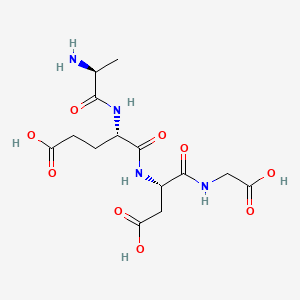
- Formula
- C14H22N4O9
- Weight
- 390.35 Da
- Length
- 4 amino acids
- PubChem CID
- 219042
- Exact Mass
- 390.1387 Da
- LogP
- -5.5
- TPSA
- 225 Ų
- H-Bond Donors
- 7
- H-Bond Acceptors
- 10
- Rotatable Bonds
- 12
- Complexity
- 607
Identifiers (SMILES, InChI)
InChI=1S/C14H22N4O9/c1-6(15)12(25)17-7(2-3-9(19)20)14(27)18-8(4-10(21)22)13(26)16-5-11(23)24/h6-8H,2-5,15H2,1H3,(H,16,26)(H,17,25)(H,18,27)(H,19,20)(H,21,22)(H,23,24)/t6-,7-,8-/m0/s1
HGHOBRRUMWJWCU-FXQIFTODSA-NResearch Indications
Anti-Aging
Activates telomerase at microgram doses to extend telomeres and cellular replicative lifespan.
Reverses aging markers and improves mitochondrial function at the cellular level.
Animal studies show 25-33% lifespan increases using 30-40mcg/kg doses.
Neuroprotection
Restores pineal gland function and circadian melatonin rhythm in elderly.
Supports new neuron formation at nanogram concentrations.
90% response rate for retinal degeneration at 5mcg per eye dosing.
Immunity
Supports thymus gland regeneration for improved immune function.
Enhanced immune surveillance and countering of immunosenescence.
Research Protocols
subcutaneous Injection
Subcutaneous injection is the primary and most researched route. Short cycles of 10-20 days with 4-6 month breaks between cycles.
| Goal | Dose | Frequency | Duration |
|---|---|---|---|
| Standard anti-aging | 200-500mcg | 1x daily for 10-20 days | —(Route: SubQ) |
| Conservative start | 100mcg | 1x daily for 10-20 days | —(Route: SubQ) |
| Russian clinical equivalent | 300mcg | 1x daily for 10-20 days | —(Route: SubQ) |
| Ultra-low dose | 50mcg | 1x daily for 10-20 days | —(Route: SubQ) |
Reconstitution Guide (mg vial + mL BAC water)
- Clean vial tops with alcohol swabs
- Add 5mL bacteriostatic water to 10mg vial (creates 2mg/mL)
- Inject water slowly at vial side wall
- Gently swirl - do not shake vigorously
- Solution should be clear and colorless
- Refrigerate immediately
- Use 0.3mL insulin syringes for accurate microgram dosing
- Use within 30 days of reconstitution
intranasal Injection
Intranasal spray offers non-invasive administration with potentially faster absorption, though less research data available.
| Goal | Dose | Frequency | Duration |
|---|---|---|---|
| Nasal administration | 1-2mg daily (corrected from traditional 5mg) | 1x daily for 10-20 days | —(Route: Nasal spray) |
oral
Oral administration has reduced bioavailability due to digestive breakdown. Less predictable effects compared to injectable.
| Goal | Dose | Frequency | Duration |
|---|---|---|---|
| Oral administration | 2-3mg | 2x daily for 10-20 days | —(Route: Oral) |
Interactions
Peptide Interactions
Both work through pineal pathways; may enhance circadian rhythm effects.
Enhanced immunomodulation - commonly combined in Russian protocols.
Different regenerative mechanisms.
Both are neuroprotective; monitor for cumulative effects.
Reported Research Timeline
Subtle energy improvement possible
Better sleep quality, vivid dreams (melatonin effect)
Enhanced morning energy, mood stability
Skin quality improvements, enhanced wound healing
Laboratory markers may show telomere changes
Cumulative anti-aging benefits with repeated cycles
Quality Indicators
What to look for
- White to off-white lyophilized powder
- Clear, colorless solution when reconstituted
- Certificate of analysis available (>98% purity)
- Medical-grade pharmaceutical appearance
- Proper cold-chain shipping
Caution
- Widespread dosing misinformation exists
- Many sources recommend 5-10mg based on translation errors
- Original research demonstrates microgram efficacy
- Verify supplier credentials carefully
Red flags
- Yellow or discolored powder (degradation)
- Cloudy solution after mixing (contamination)
- Missing or questionable sourcing documentation
References (8)
- [1]Telomerase Activation Study (2003)
- [2]Russian Clinical Trials (1992)
- [3]Pineal Function Study (2001)
- [4]Retinal Degeneration Study (2019)
- [5]Lifespan Extension Study (2003)
- [6]Neurogenesis Study (2020)
- [7]
- [8]
Continue researching Epitalon
Keep scientific evidence separate from commercial availability. Review how claims are evaluated, explore question-led research paths, or inspect disclosed source records without changing the editorial conclusions on this page.