Irisin
An exercise-induced myokine cleaved from the FNDC5 protein that drives white-to-brown fat conversion, enhances thermogenesis, and exerts neuroprotective effects.
Evidence-led profile
Research snapshot
- Evidence stage
- Emerging research
- References
- 8 linked sources
- Research coverage
- 1 area
- Editorial review
- Mar 8, 2026
Published by the PepGuide Editorial Team using our research methodology.
Overview
Irisin is a 112-amino acid myokine hormone discovered in 2012 by Bruce Spiegelman's group at Harvard, cleaved from the transmembrane protein fibronectin type III domain-containing protein 5 (FNDC5) in response to exercise-induced PGC-1α activation in skeletal muscle. Its discovery generated enormous excitement as a potential molecular link between exercise and its metabolic benefits. Irisin's signature function is the "browning" of white adipose tissue — it stimulates the expression of uncoupling protein 1 (UCP1) in white fat cells, converting them into beige/brown-like adipocytes that dissipate energy as heat through thermogenesis rather than storing it. This mechanism recapitulates one of the key metabolic adaptations to exercise.
Beyond adipose tissue remodeling, irisin exerts diverse biological effects across multiple organ systems. In bone, it stimulates osteoblast differentiation and cortical bone mass through integrin αVβ5 receptor signaling, suggesting a molecular basis for the skeletal benefits of exercise. In the brain, irisin crosses the blood-brain barrier and promotes hippocampal BDNF expression, enhancing neurogenesis, synaptic plasticity, and memory — providing a mechanistic explanation for exercise-induced cognitive benefits. Preclinical studies have shown irisin reduces amyloid-beta pathology in Alzheimer's disease models and protects against ischemic brain injury. These neuroprotective effects parallel those of other exercise-mimetic compounds like mots-c and complement neurotrophic strategies using semax or bdnf-targeting approaches.
Circulating irisin levels increase acutely during exercise, particularly high-intensity and resistance training, and are inversely correlated with adiposity, insulin resistance, and metabolic syndrome markers. Research into recombinant irisin as a therapeutic agent is ongoing, with preclinical studies demonstrating benefits in obesity, type 2 diabetes, non-alcoholic fatty liver disease, osteoporosis, and neurodegeneration. The therapeutic potential is tempered by challenges in large-scale production and delivery, as irisin has a short circulating half-life. Exercise itself remains the most reliable method of elevating endogenous irisin, and compounds that enhance exercise performance or PGC-1α activity — such as epicatechin, cardarine, and aicar — may indirectly support irisin production.
Research
Reported Effects
Exercise Synergy:: Most effective when combined with high-intensity interval training or resistance exercise, which naturally stimulates irisin production. Supplementation Strategies:: Ursolic acid (450mg) increases irisin and IGF-1 levels, promoting strength gains and fat loss without significant muscle mass increase. Nutrient Cofactors:: Vitamin D, omega-3s (EPA), taurine, and alpha-lipoic acid enhance irisin production and effectiveness when combined with physical activity. Time Course:: Benefits typically observed within 8-10 weeks of consistent intervention, with metabolic improvements appearing before significant body composition changes
Safety and Limitations
Safety Profile: Irisin
Common Side Effects
- Limited human data: irisin is an endogenous myokine released during exercise; exogenous supplementation data is sparse
- Injection site reactions (redness, swelling, pain) with recombinant irisin preparations
- Mild fatigue or malaise following administration
- Transient muscle soreness or aching
- Mild gastrointestinal discomfort (nausea) reported in early-phase studies
Serious Adverse Effects
- Bone metabolism effects: while irisin promotes osteoblast differentiation, supraphysiological levels could theoretically disrupt bone remodeling homeostasis
- Cardiovascular concerns: irisin affects cardiac metabolism; excessive exogenous levels may cause cardiac hypertrophy (observed in preclinical models at high doses)
- Thermoregulatory disruption: irisin drives white-to-brown fat conversion (browning); excessive thermogenesis could lead to hyperthermia or metabolic instability
- Uncharacterized long-term effects: as a research-phase compound, chronic safety profiles are unknown
- Immunomodulatory effects: irisin modulates inflammatory pathways; unpredictable effects on autoimmune conditions
Contraindications
- Active cardiac hypertrophy or hypertrophic cardiomyopathy
- Metabolic bone diseases where remodeling balance is critical (Paget's disease, osteomalacia under treatment)
- Uncontrolled hyperthyroidism (additive thermogenic effects)
- Known hypersensitivity to recombinant proteins or expression-system contaminants (E. coli, CHO cell–derived)
Drug Interactions
- Thyroid hormones: additive thermogenic and metabolic effects; potential for excessive energy expenditure and weight loss
- Diabetes medications (insulin, sulfonylureas): irisin improves insulin sensitivity; risk of hypoglycemia when combined
- Beta-blockers: may blunt irisin's cardiovascular and thermogenic effects
- Bisphosphonates and bone-active agents: complex interaction with bone remodeling; effects unpredictable when combined
- Immunosuppressants: irisin's immunomodulatory properties may interfere with immunosuppressive therapy
Population-Specific Considerations
- REGULATORY STATUS: irisin is NOT approved as a therapeutic agent in any jurisdiction; all exogenous use is experimental
- Pregnancy / lactation: no safety data; endogenous irisin levels fluctuate during pregnancy — exogenous supplementation contraindicated
- Children / adolescents: no pediatric data; effects on growth plates and developing metabolism unknown
- Elderly: may benefit from irisin's bone and muscle effects, but cardiovascular risk must be carefully evaluated
- Athletes: endogenous irisin elevation through exercise is physiological; exogenous supplementation carries anti-doping implications and uncertain safety
Common Side Effects
- Minimal Direct Effects:: No significant adverse effects reported from irisin-promoting supplements in clinical studies
- Ursolic Acid Concerns:: Some animal studies suggest potential anti-fertility effects (reduced spermatogenesis), requiring caution in younger males
- Indirect Effects:: Side effects primarily related to companion supplements (vitamin D, omega-3s) rather than irisin modulation itself
- Safety Profile:: Long-term use of irisin-promoting interventions appears safe based on multi-year exercise studies and ancient medicinal use (ursolic acid from plants)
Mechanism of Action
Irisin is a myokine (muscle-derived signaling molecule) produced by proteolytic cleavage of the transmembrane protein fibronectin type III domain-containing protein 5 (FNDC5). Exercise, particularly endurance and resistance training, upregulates FNDC5 expression in skeletal muscle through PGC-1alpha activation, leading to increased irisin secretion into the circulation.
The primary mechanism of irisin involves the browning of white adipose tissue (WAT). Irisin acts on white adipocytes, inducing their transdifferentiation into beige (or brite) adipocytes that express uncoupling protein 1 (UCP1). UCP1 uncouples the mitochondrial proton gradient from ATP synthesis, dissipating energy as heat (non-shivering thermogenesis). This process is mediated through upregulation of PGC-1alpha, which serves as a master regulator of mitochondrial biogenesis and activates the transcriptional program for the brown fat phenotype. The resulting increase in energy expenditure contributes to improved metabolic health.
Beyond adipose tissue, irisin exerts beneficial effects across multiple organ systems. In bone, it promotes osteoblast differentiation while inhibiting osteoclast activity, leading to increased bone formation and strength. In the brain, irisin crosses the blood-brain barrier and promotes hippocampal neurogenesis through BDNF upregulation, providing a molecular link between exercise and cognitive benefits. It also improves glucose homeostasis by enhancing insulin sensitivity and glucose uptake, while reducing systemic inflammation. These pleiotropic effects position irisin as a key mediator of the systemic health benefits of physical exercise.
Molecular Structure
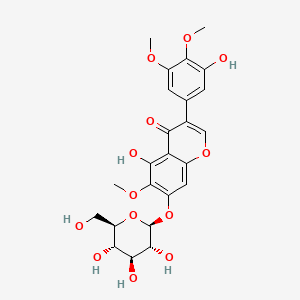
- Formula
- C24H26O13
- Weight
- 522.5 Da
- PubChem CID
- 5281777
- Exact Mass
- 522.1373 Da
- LogP
- 0.8
- TPSA
- 194 Ų
- H-Bond Donors
- 6
- H-Bond Acceptors
- 13
- Rotatable Bonds
- 7
- Complexity
- 822
Identifiers (SMILES, InChI)
InChI=1S/C24H26O13/c1-32-13-5-9(4-11(26)22(13)33-2)10-8-35-12-6-14(23(34-3)19(29)16(12)17(10)27)36-24-21(31)20(30)18(28)15(7-25)37-24/h4-6,8,15,18,20-21,24-26,28-31H,7H2,1-3H3/t15-,18-,20+,21-,24-/m1/s1
LNQCUTNLHUQZLR-OZJWLQQPSA-NReferences (8)
- [2]Irisin interaction with adipose tissue secretions by exercise training and flaxseed oil supplement
→ High-intensity interval training significantly increased plasma irisin and nesfatin-1 while decreasing resistin. Flaxseed oil supplementation combined with exercise created metabolic crosstalk between skeletal muscle and adipose tissues.
- [3]Effects of vitamin D supplementation on metabolic parameters, serum irisin and obesity values in women with subclinical hypothyroidism
→ Vitamin D supplementation in hypothyroid women improved metabolic parameters and influenced irisin levels, suggesting a connection between vitamin D status and irisin production in metabolic regulation.
- [4]Taurine supplementation increases irisin levels after high intensity physical training in obese women
→ Taurine supplementation combined with high-intensity training significantly increased irisin levels in obese women, suggesting synergistic effects for metabolic improvement.
- [5]Swimming exercise versus L-carnosine supplementation for Alzheimer's dementia in rats
→ Both exercise and L-carnosine supplementation increased hippocampal FNDC5/irisin expression in Alzheimer's disease models, demonstrating neuroprotective effects and improved cognitive function through irisin pathways.
- [6]Circulating irisin and glucose metabolism in overweight/obese women: effects of α-lipoic acid and eicosapentaenoic acid
→ Alpha-lipoic acid and EPA supplementation during weight loss programs influenced irisin production in adipocytes, with positive associations between irisin and improved glucose metabolism.
- [7]Prospective effects of cholecalciferol supplementation on irisin levels in sedentary postmenopausal women
→ Vitamin D supplementation for 12 months in postmenopausal women with hypovitaminosis D increased irisin levels, suggesting vitamin D's role in muscle-bone health through irisin modulation.
- [8]Correlation between the blood level of irisin and the severity of acute myocardial infarction in exercise-trained rats
→ Exercise training increased serum irisin levels and reduced severity of myocardial infarction, demonstrating cardioprotective effects through irisin-mediated mechanisms.
- [1]Recent Advances in Nutraceuticals for the Treatment of Sarcopenic Obesity
→ Irisin supplementation enhances oxidative metabolism, prevents insulin resistance and obesity, and improves bone quality. It is recommended for increasing muscle mass and reducing body fat in aging populations with sarcopenic obesity.
Continue researching Irisin
Keep scientific evidence separate from commercial availability. Review how claims are evaluated, explore question-led research paths, or inspect disclosed source records without changing the editorial conclusions on this page.